
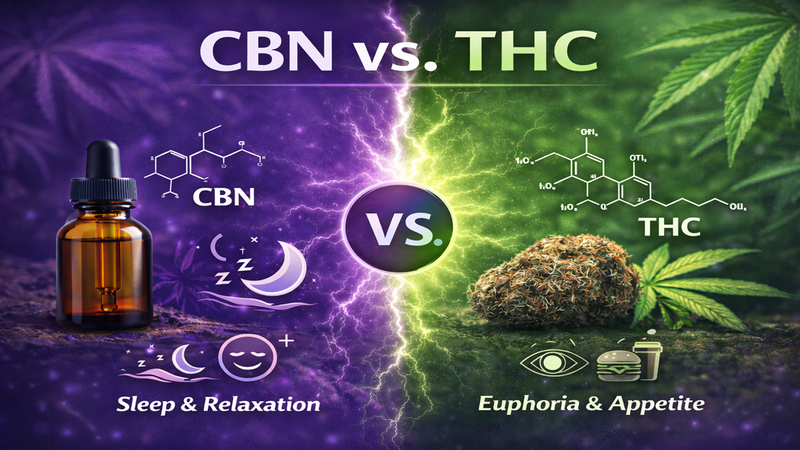
Cannabinol vs THC: Effects and Key Differences
Key Takeaways
- CBN vs. THC Both CBN and THC originate from the cannabis plant. CBN primarily develops as THC ages and oxidizes, which is why it’s abundant in older material. THC is powerfully psychoactive, and CBN is just mildly intoxicating.
- Chemically, CBN is an oxidation product of THC and binds CB1 receptors five to ten times more weakly than THC but relatively more selectively for CB2. Both are partial agonists at CB1 and CB2, but THC produces more potent brain impacts and CBN skews toward peripheral and immune effects.
- THC activates CB1 and CB2 in addition to other targets including GPR55, GPR18, PPARγ, and TRPA1, expanding its effects beyond various systems. CBN requires substantially higher doses to produce significant intoxication, so it can be considered when users prefer lighter effects.
- THC is an established treatment for sleep, appetite, nausea, and some forms of pain. It introduces obvious psychoactive and cognitive side effects. CBN’s potential for antimicrobial effects, gut motility, and immune-related pain support is promising. However, research is scarce and dosing is less established.
- There’s good reason to believe cannabis compounds can synergize, a phenomenon known as the entourage effect, particularly in whole-plant preparations that combine cannabinoids with terpenes. When possible, users and clinicians can look for tried formulations that mix compounds rather than depend solely on isolated CBN or THC.
- THC laws tend to be harsh. CBN lives in a legal gray area that varies from country to country and even within regions. Before purchasing or consuming any product, verify up-to-date local laws, verify third-party testing, start low and monitor your response.
Cannabinol vs THC is a comparison of two cannabinoids that engage the body differently, particularly related to sleep, recovery, and psychoactive properties.
Cannabinol (CBN) is mildly psychoactive and commonly associated with sleep support, while THC is highly psychoactive and causes the traditional cannabis “high.
Knowing how they differ in mechanism, dosage, and effect on training and everyday function prepares you for the more detailed analysis that follows.
The Origins of CBN and THC
Knowing where CBN and THC come from helps frame them as tools, not shortcuts. Both reside within a deep scientific and cultural tradition, not a fad manufactured last year in a marketing lab.
CBN was the first cannabinoid ever isolated. In 1896, researchers isolated it from hashish — decades before anyone had any idea what THC was. Back then, the science was muddled. Wood named “cannabinol” a dense “red oil” extract containing CBN in addition to other cannabinoids. That mix-up persisted for decades.
In the 1930s, Cahn finally drew a line: “raw cannabinol” was the red oil mix and “cannabinol” was the purified compound. Even then, CBN’s complete structure wasn’t nailed down until 1940. It appeared insignificant and unimpressive, in part because it appeared in degraded material and had none of the cultural spotlight THC would eventually receive.
THC took a separate route. Both CBN and THC are phytocannabinoids, molecules the cannabis plant produces, but they come about in different ways. In the living plant, THC is biosynthesized from cannabigerolic acid (CBGA) to THCA, then converted to THC when heated or aged.
CBN is overwhelmingly a downstream byproduct. As THC sits in air, light, and time, it oxidizes and converts to CBN. That’s why older cannabis, badly stored flower or long-exposed extracts all demonstrate elevated CBN content and diminished THC strength. From a performance mindset, it is like watching a high-output sprinter slowly turn into a steady jogger: same “family,” very different profile.
THC’s structure was finally determined in the 1960s, and that one step changed it all. Once Δ9‑THC was mapped, chemists could begin synthesizing cannabinoids in the lab, and that synthetic work in the early 1960s spurred curiosity about how these molecules actually functioned in the human body.
THC’s structure pushed researchers to ask what these compounds bind to. That question led to the discovery of cannabinoid receptors and the endocannabinoid system—a key regulatory system for mood, pain, appetite, and others. It’s here where the discussion shifts from ‘plant drug’ to ‘inherent human communication network.’
CBN never received the same attention. It’s only mildly psychoactive compared to THC with a softer, gentler profile. Early on, that worked against it. One odd historical note: C. R. Marshall reportedly ingested about 100 mg of “red oil” (containing CBN and others) simply to ease boredom while distilling diethylzinc.
That sort of cavalier self-experimentation contributed more static than sense. For years, CBN fell under the heading of “minor cannabinoid,” dwarfed by THC’s clear psychoactive value and recreational appeal.
Today, the world is different. Cannabis has been used for at least 5,000 years, with early Chinese records detailing both recreational and medicinal use. Contemporary science is at last following that lengthy trail.
Interest in cannabis and isolated cannabinoids, both for potential therapeutic use and reported risks, has soared in recent years. In that context, CBN and THC are no longer about “getting high.” They exist as levers being investigated that may modulate sleep, pain, and recovery, with distinct cost-benefit profiles based on dose, timing, and individual biology.
Comparing CBN vs THC Chemistry
CBN and THC belong to the same family and act very differently in the body. For anyone who cares about stable sleep, clean recovery, and mental control, that chemistry gap matters more than the marketing.

THC (C₂₁H₃₀O₂) is the “fresh” molecule. CBN (C₂₁H₂₆O₂) is essentially aged and oxidized THC. As THC degrades from oxygen, light, and time, its structure transitions from a more flexible, saturated form to one that is more rigid and oxidized.
That little tweak steals CBN four hydrogens, and along with them, much of THC’s psychedelic impact. You can see this in older cannabis: less sharp euphoria and more heavy, sleepy feel. Same plant, different chemistry over time.
THC is the more potent driver at receptors. It binds CB1 receptors in the brain with roughly 5 to 10 times higher affinity than CBN. That high CB1 engagement is what produces the classic high: euphoria, altered perception, and, in some people, anxiety or paranoia.
Both THC and CBN are partial agonists at CB1 and CB2, but THC hits CB1 harder and more obviously. CBN leans the opposite direction. It is more selective for CB2 receptors, which also abound in immune and peripheral tissues. That corresponds with anecdotes of CBN feeling more body-weighing, sedating, and less cerebral.
Pharmacokinetics is important for convalescence. THC has a shorter functional half-life. For some, that means a clear rise and fall: noticeable onset, peak, then taper, with lingering metabolites like 11-hydroxy-THC and 11-nor-9-carboxy-THC sitting in the system longer than the perceived effects.
CBN goes slower. A longer half-life and CB2-leaning profile probably help explain its reputation as a sedative with staying power and night-time use. That can help sleep and down-regulation, but it implies scheduling around potential morning grogginess, particularly if training early.
They both overlap in pain and neuroprotection. THC can dull pain signals through CB1-mediated signaling, which is helpful but dulls the mind. CBN appears to have much more anti-inflammatory and neuroprotective potential with little psychoactivity, which is great if you’re concerned about joint stress, extended training blocks, and remaining clear-headed.
Both are metabolized in the liver, with THC converting primarily to 11-hydroxy-THC, while CBN can be transformed into other cannabinoids, including trace quantities of THC, adding an extra layer to their interplay.
Used together, they may work synergistically. THC provides stronger analgesia, CBN moderates the intensity, extends sedation, and possibly smooths side effects. For a performance-minded person, that balance often matters more than any single molecule.
Property | THC (Δ9‑THC) | CBN (Cannabinol) |
Formula | C₂₁H₃₀O₂ | C₂₁H₂₆O₂ |
Origin | Native plant cannabinoid | Oxidation product of THC |
CB1 affinity | High; ~5–10× higher than CBN | Low–moderate |
CB2 affinity | Moderate | Higher selectivity than for CB1 |
Receptor role | Partial agonist at CB1/CB2 | Partial agonist at CB1/CB2 |
Psychoactivity | Strongly psychoactive | Minimally or non‑psychoactive |
Typical effects | Euphoria, altered perception, anxiety | Sedation, relaxation, mild pain relief |
How CBN and THC Interact
CBN and THC co-exist in the same system but act differently. For anyone who cares about performance, sleep, and long-term stability, those details of that interaction matter more than any marketing claim.
THC is the main culprit. It binds strongly to CB1 receptors in the central nervous system and more moderately to CB2 receptors in the immune system. That strong CB1 activation is why THC is clearly psychoactive: altered perception, time distortion, and a stronger “high.
CBN, by contrast, has very low affinity for both CB1 and CB2, closer to CBD than to THC. It can still activate these receptors, but weakly, which is why CBN is minimally psychoactive. THC is like a bonfire siren at CB1 and CBN is like a whisper.
CBN is a metabolite of THC. Over time, particularly with heat, light, and oxygen, THC degrades and oxidizes into CBN. That means older weed or badly stored stuff leans toward higher CBN and lower THC. Others experience these vintage products as more couch-lock and less razor-focused, which probably has to do with that ratio shift.
Since CBN binds weakly to CB1, it generally requires much higher doses to come anywhere close to intoxication than THC. For a performance-minded user, this difference in ‘dose to effect’ is significant. THC at 5–10 mg can be very strong.
CBN at comparable doses is often subtle or almost imperceptible, in the background more than the foreground. CBN seems to skew a bit more toward CB2-related pathways and may function as an inverse agonist or antagonist at CB receptors in certain circumstances.
Put simply, that means CBN may partially blunt or reshape the signal that THC is delivering, particularly at CB1. Some preliminary research indicates CBN may dampen some psychotropic effects of THC, while it may potentiate its sedative effects.
For example, THC alone can feel more “mentally high,” whereas THC and CBN can feel more “heavy and sleepy.” THC extends beyond CB1 and CB2. It interacts with GPR55, GPR18, PPARγ and TRPA1.
These additional targets expand its effect to domains such as pain signaling, vascular tone, inflammation, and metabolic regulation. CBN lacks this wide range of involvement, so its biological profile is more limited and frequently more subtle.
The synergy between CBN and THC probably creates a different effect profile than THC alone. We’re still mapping out how exactly. Most of what we do have are preliminary studies, animal data, and anecdotal evidence, not large, controlled human trials.
For the regulated user, that means approach CBN–THC blends as uncharted waters, not a tried-and-true instrument.
Therapeutic Potential of CBN vs THC
Therapeutic use always comes down to tradeoffs: effect, side effects, and how that fits the bigger system of training, sleep, and work. CBN and THC occupy very different positions on that map.
THC is the better mapped compound. It is more potent than CBN and clearly more psychoactive. A rough estimate is that CBN sits around 25 percent of THC’s effect, depending on dose and person. Medically, THC is used in several countries for sleep induction, appetite stimulation, and anti-nausea support, especially in chemotherapy.
At low to moderate doses, it can reduce anxiety in some people, while higher doses can flip that and increase anxiety, especially in stress-prone users. THC has shown benefit for pain, inflammation, and spasticity, which is why it shows up in contexts like neuropathic pain or multiple sclerosis. For an athlete, that can mean less pain and better appetite on heavy blocks, but more cognitive drag if the dose is off.
CBN is less defined but interesting. It’s not a medicine so far; most of what we’ve got is preliminary data and anecdotal information. Lab studies indicate CBN has antimicrobial properties, including against certain antibiotic-resistant bacteria.
It appears to slow gastrointestinal motility, which may be significant in cases where the gut is hyperactive but could cause an issue in individuals who already experience constipation or slow digestion. Performance-wise, there’s some data and plenty of anecdotal evidence suggesting that CBN is more sedating than THC, with individuals taking it for sleep and relaxation.
That corresponds with its weaker psychoactivity and potential GABA-related actions, but the data remains sparse. For pain, THC is the primary driver. It binds directly to CB1 receptors in the central nervous system and produces clear analgesic effects along with reductions in inflammation and muscle spasticity.
That comes with a cost: cognitive impairment, especially at higher doses, such as slower reaction time, altered judgment, and memory issues. CBN may support pain relief more indirectly. Early work hints at anti‑inflammatory and immune‑modulating effects, which could matter in arthritis, autoimmune pain, or long‑term joint irritation.
The signal is early, and dosage ranges are not well established. In terms of side effects, THC brings more obvious psychoactive and cognitive changes. CBN’s profile looks milder, being more “background sedative” than “head high,” but it is less studied, so the unknowns are larger.
The Entourage Effect Myth
The ‘entourage effect’ key phrase gets thrown around like a catchphrase, particularly in cannabis marketing. For performance-minded people, it is more useful to treat it as a working hypothesis, not a guarantee.
The general concept is straightforward. Several cannabis compounds at once, including cannabinoids and terpenes, might produce a more potent or expansive effect than any one molecule by itself. In this paradigm, THC and CBN are not solo agents. They are a piece of a puzzle, engaging one another, engaging terpenes like myrcene or limonene, and engaging your endocannabinoid system.
The idea was originally proposed by Mechoulam and Ben‑Shabat to describe how “supporting players” in the endocannabinoid system amplify the lead signalers. Think of it less as magic and more as basic network behavior: small inputs combining to shift the whole system. The favorite trope is a symphony. THC or CBN are the soloists, while terpenes and minor cannabinoids are the orchestra. The tune you experience is the chorus, not the lead.
Both THC and CBN could feasibly be contributing to this synergy. THC contributes potent CB1 receptor activity, changing pain, mood, and cognition. CBN binds more weakly and perhaps skews further towards sedation while smoothing THC’s rough edges.
In practice, that could translate to a given THC-dominant product hitting fast and hard, while a THC plus CBN version of the same total mg dose comes across smoother with a different curve for pain relief, sleep onset, or anxiety. That’s the assertion. Data is still thin.
Whole‑plant or “full‑spectrum” products try to preserve this orchestra: multiple cannabinoids, terpenes, and minor compounds. Isolates reduce it to a single molecule—THC, CBN, CBD. Certain research indicates full‑spectrum extracts decrease inflammation or pain more than isolated THC or CBD at an equal dose.
Outcomes are inconsistent, and not all full‑spectrum products are created equal. Ratios are important. Terpene content is important. Your own biology counts.
It’s a myth that all full‑spectrum products work the same for everyone. One person may discover a CBN plus THC plus myrcene profile perfect for sleep. Another might be groggy and flat the following day.
A limonene‑rich THC product might feel mentally lighter for one user and anxious for another. This is why serious lifters treat cannabinoids like load and volume: adjust one variable at a time, watch recovery, sleep quality, mood, and training output over weeks, not hours.
Navigating CBN and THC Legality
Legality is the piece of the equation everyone overlooks until it’s an issue. CBN and THC with the rules are layered, shifting, and frequently not obvious. If you care about control and long-term consistency, you don’t outsource this piece.
THC remains a controlled substance in most jurisdictions. In the US, that typically means weed with more than 0.3% THC by dry weight is governed by more stringent “adult-use” or medical regulations. Cultivation, sale, and consumption are connected to state-approved programs, licensing, and testing.
Access is going to be very different in a state with regulated medical and/or recreational cannabis than in a state with limited hemp products. THC is banned in some countries, is for medical use only in others, and a handful have full adult-use markets with stringent regulations.
There is one narrow carve-out: hemp-derived THC at concentrations up to 0.3% on a dry weight basis is not considered a controlled substance under U.S. Federal law. That’s the reason you hear about “hemp delta-9” gummies or drinks. ‘Not controlled’ does not mean ‘anything goes.’
Those items still need to meet other legal requirements, such as the Food, Drug, and Cosmetic (FD&C) Act, and states can still limit or prohibit them.
CBN, on the other hand, sits in a murkier lane. It appears as a minor cannabinoid in aged cannabis and hemp, and its legality largely depends on how a country or state handles “cannabis-derived compounds” broadly. In the U.S., cannabis products with CBN are only available in states with regulated medical and/or recreational cannabis programs.
The science isn’t new—CBN pre-clinical research goes as far back as the 1940s—but the results are equivocal. Certain research indicates sedative properties, while some find no significant psychoactive impact. Regulators sense that uncertainty and tread carefully.
Above that, the U.S. Food and Drug Administration adds its own level. Even if a CBD or CBN product falls within the 2018 Farm Bill definition of “hemp,” it still must comply with the FD&C Act. The FDA has provided guidance on cannabis and cannabis-derived compounds, including a January 2023 document on quality considerations for clinical research.
If a brand intends to sell dietary supplements with NDIs like CBN or THC, it must notify the FDA. For cosmetics, it is adulterated if it contains a poisonous or harmful substance under normal use as labeled. That matters for CBN sleep creams or THC topicals purporting to be “cosmetic only.
Others even have numeric retail limits. For example, certain U.S. States allow products containing 2.5 mg or less of adult-use cannabinoids such as THC per serving, with at least a 15:1 ratio of non-intoxicating cannabinoids like CBD or CBN to adult-use cannabinoids to be sold to the general public outside dispensaries.
That type of framework seeks to blend availability with protection, mini doses, minimal intoxication potential, and obvious labeling.
Bottom line: The legal map for CBN and THC is fragmented. Navigating CBN and THC legality, availability, dose limits, and product types shift across borders and sometimes even between neighboring states.
If you are going to fold either compound into your recovery system, treat legality like you treat programming: verify, do not assume.
Check your local laws on possession, purchase, and use before you buy, travel, or dose!
Conclusion
CBN and THC come from the same plant and similar roots. They have very different roles in how cannabis feels and functions.
THC fuels the traditional “high” and continues to be the dominant psychoactive compound. CBN tends to be more of a byproduct of aging THC with gentler effects and emerging, still-limited research surrounding sleep and relaxation.
Some of the CBN hype as a miracle sedative or sure-fire sleep aid outpaces the science. Ditto for vague ‘entourage effect’ claims without transparent dosing and evidence.
For a serious, long-term approach, the smart move is simple: know what each cannabinoid does, track how your own body responds, stay inside your local laws, and treat both THC and CBN as tools, not shortcuts.
Frequently Asked Questions
What is the main difference between CBN and THC?
CBN (cannabinol) is mildly psychoactive and typically develops as THC matures or oxidizes. THC (delta-9-tetrahydrocannabinol) is potently psychoactive and induces the traditional ‘high.' Both engage the endocannabinoid system, however, in diverse methods and intensities.
Does CBN get you high like THC?
CBN can cause mild relaxation or drowsiness. It is far less psychoactive than THC. THC potently stimulates CB1 receptors in the brain, sparking euphoria and intoxication. Most folks don’t say they get super “high” from average CBN levels.
Is CBN better than THC for sleep?
Initial studies and user anecdotes propose CBN might promote sleep, particularly in combination with other cannabinoids. THC can aid sleep for some, but it can fragment sleep or cause next day grogginess. Research remains scarce, meaning results may vary individually.
How do CBN and THC work differently in the body?
THC binds tightly to CB1 receptors in the brain, fueling the majority of psychoactive experiences. CBN’s binding is weaker and it may interact with other receptor types. This distinction probably accounts for why THC is more potent-feeling and CBN is more sedating than intoxicating.
Is combining CBN and THC more effective than using them alone?
Others experience superior relaxation or sleep with CBN and THC together. The “entourage effect” is just a theory, not entirely proven. Advantages might be dose, ratio, and biology dependent so results can vary significantly.
Are CBN and THC legal everywhere?
THC remains tightly regulated or illegal in most countries and regions. CBN’s legality is more nuanced and typically depends on its origin (hemp or marijuana) as well as the jurisdiction. As always, verify your national and local laws prior to purchasing or consuming these products.
Is CBN safer than THC?
CBN seems to have a milder psychoactive profile than THC, which can potentially lessen impairment risk. Long-term safety data for CBN are still limited. THC has cognate side effects like anxiety, rapid heart rate, and impaired driving. Use them all with caution, particularly if you’re new to cannabinoids.
Additional Topics: