
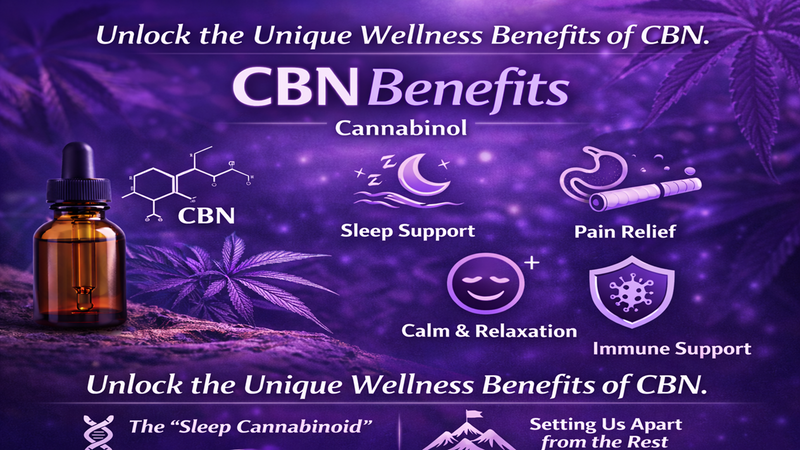
Cannabinol (CBN): Rest, Relaxation, and Balance?
Key Takeaways
- Cannabinol or CBN is a mild, mostly non-intoxicating cannabinoid that may support sleep, pain relief, appetite, and neuroprotection largely through its interaction with CB1 and CB2 receptors in the endocannabinoid system. Both its antioxidant and anti-inflammatory actions are at the core of these potential benefits.
- CBN comes from THC decomposing in aged cannabis, so older plant matter is likely to have more of it. Compared with THC and CBD, CBN is less psychoactive than THC but potentially more supportive of sedation than CBD for certain individuals.
- Preliminary research indicates CBN might assist chronic pain, insomnia, appetite loss, and some neurodegenerative diseases. Human evidence remains sparse. It’s an adjunct, not monotherapy.
- As a practical matter, use generally begins with low oral doses of CBN oils, tinctures, capsules, or edibles administered in the evening, with incremental adjustments according to effectiveness and side effects such as sleepiness or lightheadedness. Pairing CBN with CBD or low doses of THC is being investigated for improved sleep and pain relief.
- Quality control is key since unregulated CBN products can be laced with impurities, inaccurate doses, or leftover contaminants like heavy metals and solvents. By selecting third-party tested products and speaking with a healthcare professional about CBN use, you can help mitigate risks and drug interactions.
- The legal and regulatory environment for CBN continues to develop, particularly in regions with stringent cannabis legislation. Certain items can result in positive drug test results owing to THC presence. Upcoming clinical trials, pharmaceutical formulations, and clearer regulations will probably determine CBN’s place in mainstream medicine and specific symptom targeting.
Cannabinol benefits refer to the potential effects of CBN on sleep quality, relaxation, and pain perception without strong intoxication. Preliminary evidence indicates CBN might promote deeper rest, assist in managing the sleep-wake rhythm, and more mildly modulate inflammation than THC. For performance and recovery-minded individuals, CBN frequently decorates low-dose blends aimed at stilling the nervous system come bedtime. These sections dissect what we already know.
Exploring Cannabinol Benefits
Cannabinol (CBN) occupies the “support” column, not the “shortcut” column. A minor cannabinoid, cannabinol demonstrates measured potential across pain, sleep, and neuro-related symptoms, mostly as quiet background support rather than a dramatic on or off switch.

Evidence points to several areas where CBN may help:
- Chronic pain
- Insomnia and general sleep disturbance
- Appetite loss and low intake during illness
- Neurodegenerative diseases and related neuropsychiatric symptoms
- Tourette syndrome and tic disorders
On pain, CBN seems more like an additional instrument in the arsenal than a magic bullet. One meta-analysis found an odds ratio of 3.43 with a 95% confidence interval of 1.03 to 11.48 for pain relief versus placebo. That’s encouraging, not conclusive. For a guy with chronic joint or neuropathic pain trying to maintain consistent training volume, that sort of incremental edge can be the difference, especially when it supplements, not supplants, strength work, mobility, and sleep.
Sleep is where CBN gets most of its attention. One noted weighted mean difference in sleep quality of -0.58 with a 95% confidence interval of -0.87 to -0.29 compared to placebo, while the wider cannabinoid meta-analysis showed a smaller but still impressive effect size of -0.26 with a 95% confidence interval of -0.52 to 0.00. In a crossover trial, nabilone, a CBN-related compound, beat amitriptyline for insomnia and sleep restfulness in fibromyalgia. That indicates CBN’s role is more about stabilizing broken sleep than sedating you.
CBN carries antioxidant and anti-inflammatory activity, which may help explain signals seen in tougher conditions. In one trial, 18% of children had a 75 to 100% seizure reduction. Another 6-week study in Tourette syndrome found reduced tics. Neuropsychiatric measures, like the UHDRS behavioral assessment and neuropsychiatric inventory, improved in some patients with neurodegenerative disease. On appetite, a cannabis extract containing CBN led to 73% of patients reporting increased appetite, versus 58% with THC and 69% with placebo, showing CBN is not simply a weaker THC clone.
CBN’s sedative profile tends to be milder, with less intoxication and more ‘edge softening.’ It seems to lean into relaxation and sleep support without the same cognitive disruption or intense psychoactive load. Among minor cannabinoids, it distinguishes itself for this soothing, wind-down duty—helpful if your objective is regular restorative sleep, not a pharmaceutical blackout.
How Cannabinol Works
CBN works better as infrastructure than it does as a shortcut. Cannabinol works quietly in the background of your nervous system, not as a jolt, but as a modulator. This compound binds to the endocannabinoid system, primarily via CB1 and CB2 receptors. It binds weakly to CB1 receptors in the brain, so it doesn’t generate the strong “high” that THC does. It’s more active at CB2 receptors, which reside predominantly in immune and peripheral tissues associated with inflammation. That CB2 lean, along with its antioxidant and anti‑inflammatory activity, probably explains why CBN is exhibiting early promise for pain relief, inflammation, and simply calming effects. The mechanism is not fully mapped, but data indicates that CBN encourages the system toward downregulation over overstimulation.
CBN is literally ‘what happens to THC when it gets old.’ In plant matter and stored goods, oxygen, heat, and light gradually transform THC to CBN through oxidation. Marijuana that is older or improperly stored will often have more CBN and less THC. Since CBN is chemically stabler, it sticks around longer. High CBN has been found in cannabis plant material dating back to approximately 750 BC. Modern oils and extracts can have CBN naturally from this degradation or via targeted processing.
Compared with THC and CBD products, CBN sits in the middle. It is often called non-psychoactive, but a more accurate description is “mildly intoxicating at higher doses.” On its own, it tends to feel more sedative than euphoric. In animal studies, CBN plus THC increased sedation and reduced pain more than THC alone, suggesting a synergistic effect. That synergy is interesting for people who want less total THC but still need help with sleep or discomfort.
CBN’s chemistry is an oxidized, aromatized variant of THC. Its metabolites tend toward anti‑inflammatory, antioxidant, and potentially anxiolytic properties rather than pronounced psychoactivity. That’s why it’s being studied for sleep, pain, and recovery support, not recreation. The therapeutic uses of CBN are gaining attention, especially as more research highlights its potential health benefits for various conditions.
As cannabinoid research continues to evolve, the interest in CBN and its therapeutic potential grows. This compound, along with other major cannabinoids, may play a significant role in the future of medicinal cannabis legislation and treatment options. Understanding the pharmacological actions of CBN can lead to innovative approaches in managing health issues and improving overall well-being.
Cannabinol Versus Others
Cannabinol (CBN) sits between CBD and THC in effect profile. It is milder than THC, more sedating than standard CBD, and generally quieter in the background than both.
Compound | Relative Potency | Psychoactive Effects | Main Therapeutic Angles |
CBN | ~25% of THC | Mild, low “high” | Sleep support, relaxation, possible pain modulation |
CBD | Non-intoxicating | Clear-headed | Anxiety, inflammation, seizure control, broad neuromodulation |
THC | 100% reference | Noticeable “high” | Pain relief, appetite, nausea, spasticity, but with cognitive impact |
CBN is approximately 25% of the strength of THC, so it’s a mild dose for those who work out, labor, and get the kids to sleep all within the same 24-hour period. It doesn’t fire up the nervous system like THC, and it doesn’t have the wide-reaching neuromodulatory footprint of CBD. In medical cannabis, THC continues to do most of the heavy lifting around pain and appetite. CBD frequently forms the cornerstone of protocols for anxiety, epilepsy, and inflammation. CBN appears more as a specialist—primarily sleep and “wind-down” support—than a lead driver.
CBD is pharmacologically busier. It is a negative allosteric modulator at mu- and delta-opioid receptors at fairly high concentrations of 30 to 100 micromolar, which puts a cap on how much you can rely on that at typical dosing. Human data indicate inhaled CBD at 400 mg can blunt THC at 12 mg-induced changes in mismatch negativity amplitude. This means it can mitigate some perceptual disruption. CBD at 10 mg per kilogram in rats reduces ethanol place preference and aggressivity, and reshapes low-frequency brain activity and connectivity in adults with autism on fMRI at high oral doses of 600 mg. THC, by contrast, can create longer-term shifts. Adolescent exposure at 2.5 to 10 mg per kilogram for 10 days in rats alters dopamine receptor function and dysregulates glutamate receptor expression into adulthood. CBD doesn’t quite ‘fix’ THC either, as it does not reverse hypothermia or locomotor suppression when THC doses are higher at 30 mg per kilogram administered intraperitoneally.
On symptoms, CBN products are most likely to be aimed at sleep, typically in combination with low-dose THC or CBD. A lot of users experience smoothed-out sleep onset and less mental “spin,” particularly in sublingual tinctures, where bioavailability can get as high as 40 to 50 percent. CBD leans harder on anxiety reduction, inflammation and daytime stability. THC is still the most potent for acute pain, but it carries trade-offs in cognition, motivation and occasionally mood. For someone who values steady output, CBN is more of a low-intensity lever: useful for nudging the system toward rest and less suited as a standalone fix for significant pain or complex mood disorders.
Practical Cannabinol Use
Practical CBN use is about optimizing the system, not pursuing an experience. Translation: transparent dosage, pure medications, and gradual, controlled experimentation within your own system.
While the majority of human work on CBN still employs oral isolate. Animal data indicates oral CBN can increase non-rapid eye movement (NREM) sleep and increase sleep bout duration, aligning with the “deeper, more continuous sleep” narrative. It’s still early. In humans, oral CBN has been researched for sleep quality, next-day function, driving performance, mood, and postural sway. These studies measured better perceived sleep depth and efficiency with tools like the Leeds Sleep Evaluation Questionnaire, but data is mixed and not conclusive. Additionally, there’s some evidence CBN could have biphasic effects on sleep, first briefly decreasing REM, then increasing it approximately 4 hours later. This further emphasizes the importance of monitoring your response over multiple nights, not just one.
For healthy adults, many brands fall in the 5 to 30 mg oral range at night. A conservative system is to start around 2.5 to 5 mg CBN, hold for 5 to 7 nights, then step up by 2.5 to 5 mg only if needed. Beware of “mega-dose” marketing. Intravenous CBN at high infusion rates of approximately 1.2 mg per minute has caused mild intoxication; that has not been seen with typical oral doses, but it’s a reminder that more is not better.
Product quality matters more than label promises. Look for:
- Third-party lab reports provide CBN content, other cannabinoids, heavy metals, pesticides, and solvents.
- Batch numbers that match lab reports, not generic PDFs.
- Explicit disclosure if it’s CBN isolate, broad-spectrum, or full-spectrum, so you’re aware of how much CBD or THC you may be ingesting.
Incorporate CBN like any recovery asset. If you already take magnesium glycinate, glycine, or low-dose melatonin, introduce CBN at the lowest dose and modify nothing else for at least a week. CBN and CBD combination formulas are being trialed in randomized controlled trials against placebo, so you want to judge by your own latency, wake-ups, and next-day sharpness. Some will fare better on CBN alone, while others will do better on a light CBN and CBD mix.
Potential Risks
Cannabinol (CBN) sits in the broader cannabis ecosystem, so its risks intersect with cannabis as a whole. Anyone training hard and thinking long-term should treat it like any other tool: useful in the right context, but not free.
Common side effects: * Drowsiness and next-day grogginess, particularly at larger dosages.
Dizziness or lightheadedness upon standing.
Cottonmouth and bloodshot eyes.
Slight disruptions in coordination or reaction speed.
Headache or nausea in certain users.
At higher doses, those effects can accumulate. If you’re driving, lifting heavy objects, or doing technical work, slower reaction time and impaired attention are real problems, not minor inconveniences.
CBN can interact with prescription medications. It can affect liver enzymes that process a number of medications, such as anti-epileptic drugs, blood thinners, and certain antidepressants. That can translate to elevated or diminished drug levels. Anyone on long-term medication, particularly for seizures, heart issues, or mood, should clear CBN with a physician first.
Most CBN products reside in a regulatory gray zone. Labels could be off. A few oils and gummies have come up with surprising THC, synthetic cannabinoids, pesticides or heavy metals. For a recovery junkie, introducing chronic toxin exposure is counterintuitive. Third-party testing, batch certificates, and clear sourcing matter more than flavor or marketing claims.
Psychoactive risk is generally lower with CBN than THC. It’s not zero. At higher doses or in sensitive people, you can see:
Slower thinking, weaker short‑term memory, and poorer decision-making
Anxiety, low mood, or paradoxical agitation
Worsened sleep architecture despite feeling sleepy
Broader cannabis data points to higher risks with heavy, long-term use. These include an increased risk of psychosis in vulnerable people, higher odds of anxiety and depression, tolerance and withdrawal symptoms such as irritability, insomnia, and restlessness, respiratory and cardiovascular strain if smoked, and an elevated traffic accident risk. Legal status and drug testing matter as well. Trace THC in CBN products can still trigger a failed test under strict policies.
The Future Landscape
CBN is still in its infancy, the path is becoming more defined. Much of the data is preclinical or small human studies, so the savvy approach is curiosity without commitment.
Here, recent work highlights some potential therapeutic avenues. Sedation and sleep quality get most attention. Low to moderate doses of CBN paired with other cannabinoids may help ease sleep onset and improve continuity, especially in people who run “tired but wired” from chronic stress or late training. Animal studies additionally suggest functions in pain modulation, neuroprotection, and inflammation. For instance, CBN has demonstrated promise in neuropathic pain and glaucoma models, where pressure and nerve health are paramount over years, not weeks. Early neurodegeneration work is exploratory, but researchers are eyeing it as a potential adjunct compound, not a mono therapeutic.
On the formulation side, the trend is away from “CBN gummies for sleep” and toward targeted delivery. Pharmaceutical groups and serious supplement brands are experimenting with nanoemulsions, sublingual sprays and controlled-release capsules engineered to strike more reliable absorption curves. Stacked formats are rising: CBN with specific ratios of CBD, low-dose THC (where legal), or terpenes like linalool and myrcene, tuned for different profiles—sleep onset, nighttime pain, or anxiety during recovery blocks.
Legally, CBN occupies a gray, shifting area. Other areas regulate it like any hemp product if derived from low-THC source plants. Others drag it into more general “synthetic” or “intoxicating cannabinoid” regulations, notably if derived from converted CBD. As medical cannabis laws develop, it’s more likely that minor cannabinoids like CBN will be regulated by source, method of manufacture, and supported effect, not label copy. Anticipate tougher quality norms, more transparent labeling, and added emphasis on data to support assertions.
That market will grow, not as a miracle category. CBN is best considered a niche tool that could have a defined place in sleep medicine, pain management, and long-term nervous system support, particularly when part of medically guided protocols versus gas station impulse purchases.
Conclusion
Cannabinol occupies a curious position. It is not some miracle compound, nor is it useless either. It is just another resource that could assist some folks in resting, relaxing, or regulating pain with a little deliberation and persistence.
Research is nascent. The majority of it is animal data, small human studies, and user anecdotes. This means benefits can occur, but they are not guaranteed, and there is ample room to overpromise.
For a performance-minded individual, CBN makes most sense as an experiment, not a centerpiece. Begin low, control for other variables, track sleep, mood, and next-day function. Be aware of interactions and quality of products.
If it makes your routine, it should be because your self-monitoring data says so, not the marketing.
Frequently Asked Questions
What is cannabinol (CBN) and how is it different from CBD or THC?
Cannabinol benefits arise when tetrahydrocannabinol (THC) oxidizes and degrades. Unlike THC, CBN is only mildly psychoactive and, unlike cannabidiol (CBD), CBN is less explored but could provide unique therapeutic uses for sleep and relaxation.
What are the main potential benefits of cannabinol?
Initial studies and anecdotal feedback indicate that CBN, a cannabinoid derived from the cannabis plant, could help with calming, dozing, hunger, and aches. However, research on the therapeutic uses of CBN is still sparse and primarily preclinical.
How does cannabinol work in the body?
CBN interacts with the body’s endocannabinoid system, impacting sleep, mood, pain, and inflammation signaling through its weak binding to CB1 and CB2 receptors. Current knowledge largely stems from animal and lab-based studies rather than extensive human trials, highlighting the need for more research on therapeutic uses of cannabinoids.
How should I take cannabinol for practical daily use?
Popular formats of CBD products include oils, capsules, gummies, and sleep-focused blends, which can offer various health benefits. Start with a small dose, typically at night, and increase gradually if required. Always read product labels and consult a healthcare professional, especially if you’re on other medications or have health concerns.
Is cannabinol safe, and what are the possible side effects?
CBN seems to be well tolerated for most individuals. However, there is a lack of long-term safety information. Potential side effects are sedation, dry mouth, dizziness, or appetite changes. Don’t drive or operate machinery until you know how CBN affects you.
Can I use cannabinol with other sleep aids or medications?
CBN, a cannabinoid derived from the cannabis plant, can interact with medications, including prescription drugs and OTC sleep aids, potentially impacting drug metabolism in the liver. Always consult a doctor or pharmacist before combining CBN products with any medication or dietary supplement for safety.
What does the future of cannabinol research look like?
Scientists are investigating CBN’s potential as a cannabinoid in areas such as sleep, pain relief, neuroprotection, and inflammation. Human clinical trials are required to verify health benefits, optimize dosing, and establish long-term safety for various cbd products, as interest and regulation increase.
Additional Topics: