
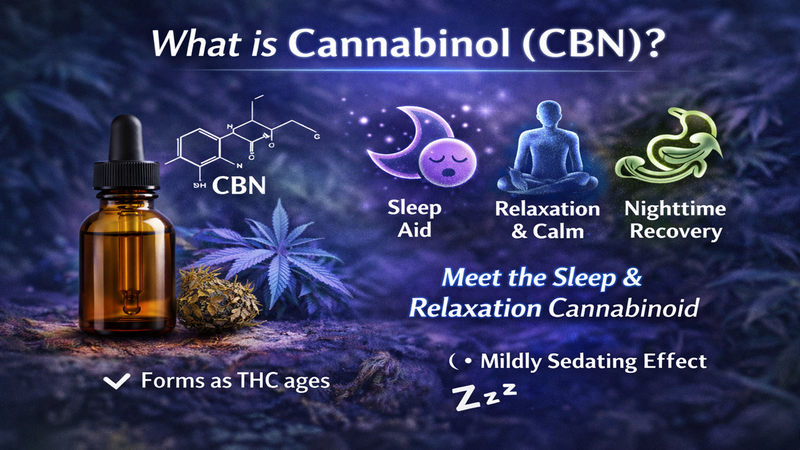
What is Cannabinol (CBN)? History and Synthesis
Key Takeaways
- Cannabinol or CBN is a minor cannabinoid that occurs when THC degrades in aged cannabis, with a unique chemical structure and slight psychoactive activity. It functions as a neutral cannabinoid and is a partial agonist at CB1 and CB2 receptors.
- CBN was the first cannabinoid to be isolated from cannabis and was previously believed to be the primary intoxicating compound. We now know it as a THC degradation product that gave cannabis its old-school sedative rep.
- CBN is made primarily by THC’s natural oxidation in stored or overaged cannabis and by laboratory semisynthesis and total synthesis. They vary in source plant, crucial reaction steps, and typical yield, which is important for consistent product quality.
- CBN has a different pharmacological profile than THC, with weaker receptor binding but noticeable effects on sleep, pain, and inflammation. Existing data supports low toxicity and favorable pharmacokinetics, but human data is still sparse.
- Unlike other cannabinoids, CBN is mildly intoxicating in comparison to THC’s potent intoxication and CBD’s non-intoxicating nature. Its source from degraded THC, low CB1 affinity and focused medicinal promise distinguish it from CBD, CBG and other phytocannabinoids.
- Real-life application requires beginning with small CBN doses, verifying product lab tests, and being mindful of personal reactions, particularly alongside THC or other sedatives. If you’re using CBN for sleep, pain, or recovery, it’s supposed to supplement — not substitute — foundational habits such as training, nutrition, and sleep hygiene.
Cannabinol is a minor cannabinoid found in the cannabis plant that develops when tetrahydrocannabinol (THC) degrades over time. It’s found in higher levels in aged cannabis and is non-intoxicating in typical doses.
Initial studies associate cannabinol with possible sleep, inflammation, and pain effects, but human evidence is sparse. To see its true role, it helps to look at what cannabinol does to the endocannabinoid system and research.
What is Cannabinol?
Cannabinol, or CBN, is a trace level plant cannabinoid that primarily appears in aged cannabis rather than in fresh flower. It develops when tetrahydrocannabinol (THC) degrades over time in the presence of oxygen, light, or heat. This degradation process leads to elevated CBN content in older weed or weed stored inadequately, highlighting the importance of proper cannabis administration.
It was initially isolated in 1896 by Barlow Wood, Newton Spivey, and Easterfield, with its structure elucidated in the early 1930s. Wood himself coined the term “cannabinol” for a thick “red oil” from which he extracted CBN alongside other major phytocannabinoids.
Chemically, CBN is a benzo[c]chromene derivative with a biphenyl-like core, making it a valuable model in synthetic chemistry. This compound has been used to test new reactions and total synthesis strategies. Structurally, it diverges from THC and cannabidiol (CBD), despite all three deriving from the same cannabis plants.
These distinctions in ring system and oxidation pattern explain why CBN acts differently at cannabinoid receptors, particularly the cannabinoid CB1 receptor, and exhibits a different effect profile. CBN is classified as a neutral cannabinoid, beginning life as cannabinolic acid (CBNA) in the plant before shedding a carbon dioxide group over time, especially during drying, curing, or storing.
That decarboxylation step is akin to how THCA becomes THC, but here it occurs primarily as the plant material ages. CBN can be synthetically generated from THC through deliberate reactions, rendering it useful to chemists outside of the supplement world as well.
In terms of function, CBN is a bioactive phytocannabinoid with light psychoactive effects. It serves as a partial agonist at cannabinoid receptors, particularly the CB1 receptor, exhibiting far weaker activity than THC. Preliminary studies suggest potential anti-inflammatory and antioxidant properties, but research remains in its early stages and is very limited in human subjects.
The History of CBN
CBN has one of the oldest paper trails in cannabinoid science, which matters if you care about what’s proven versus what’s trendy. Cannabinol, a rare cannabinoid, was the very first cannabinoid to be isolated from Cannabis sativa. Way before THC or CBD were mapped, chemists were tinkering with a viscous “red oil” derived from cannabis.
At the close of the 19th century, Wood coined the term “cannabinol” for this thick resin, which we now recognize contained CBN in addition to other major phytocannabinoids. Early on, CBN appeared to be the principal active ingredient merely because it withstood rough handling and extended shipping.
There was a major misconception: for years, CBN was thought to be the primary intoxicating agent in cannabis. Not until Δ9‑THC was isolated and tested later did it become clear that THC was the dominant intoxicant and CBN was weaker. This highlights the importance of understanding cannabinoid receptor activation, as first guesses are often wrong, even in labs.
The trail of research reflects a gradual, careful accumulation. In 1939, Todd and colleagues isolated CBN and characterized it, confirming its structure. Adams unlocked that chemical map in 1940 with the first total synthesis of CBN, showcasing the advancements in cannabinoid therapeutics.
Over time, researchers realized something important: CBN is mostly a degradation product of Δ9‑THC. Long transit times from collection fields to European labs, often over months with subpar storage, let THC oxidize and degrade into CBN. That’s why old, poorly stored weed is CBN-heavy.
From that point, business blossomed. CBN synthesis has since been accomplished by means such as the Ullmann–Ziegler cross‑coupling reaction and Pd‑catalyzed C–H lactonization. Over the decades, CBN has been researched for its synergy with Δ9‑THC and its own possible pharmacological actions such as sedation, further emphasizing its role within the cannabinoid system.
Historical medicinal cannabis tended to rely on old stock, which may account for legends that ‘old’ cannabis was better at inducing sleep.
How CBN is Produced
CBN isn’t a “flashy” cannabinoid. It surfaces gently, primarily as THC degrades over time, aligning better with long-view chemistry than fast-fix biohacking.
CBN is produced as THC oxidizes and degrades in stored or aged flower. Light, oxygen and time degrade THC into CBN, which explains why aged cannabis tends to test high in CBN and low in THC. THC can initially transform into 11‑hydroxy‑THC (THC‑OH) and then continue oxidizing into CBN. This gradual transition is part of why old flower seems more lethargic and couch-locking than new product.
Historically, CBN is the oldest known cannabinoid in the lab as well. It was originally discovered by Barlow Wood, Newton Spivey and Easterfield in 1896. Cahn determined its structure in the early 1930s, which made CBN the first completely characterized cannabis compound and the foundation for early cannabis extract development.
For curated goods, makers don’t wait years for mother nature to age them. They rely on synthesis:
- Semisynthesis from THC-rich extracts. How CBN is Manufactured Producers begin with cannabis THC, then steer managed oxidation to CBN. Conditions such as oxygen, heat, and catalysts are optimized toward CBN rather than random decomposition. This path exploits the plant’s existing scaffold, thus the tricyclic CBN structure is ‘copied’ rather than constructed from scratch. It is efficient for scale production and usually provides medium to high yields when the process is optimized.
- Complete syntheses by chemical means. Here, CBN is constructed stepwise from simpler molecules. One popular approach is linking two aromatic segments to join potential rings A and C, then promoting an intramolecular cyclization to close ring B and provide the tricyclic core. This typically transpires via a biphenyl intermediate, which then rearranges to the CBN scaffold. Several variants exist:
- Pd-catalyzed C–H lactonization to biaryl lactones which then undergo transformation into the CBN skeleton.
- Cuprate and iodobenzamide to construct the biphenyl, then demethylation and acid-catalyzed cyclisation.
- The Göttlich approach, installing geminal dimethyl groups via two equivalents of methyllithium and then closing with trifluoroacetic acid, approximately 85% over two steps.
A simplified comparison of production routes:
Method | Source material | Key steps | Typical yield* |
Natural THC degradation | Aged cannabis / marijuana | Slow oxidation of THC to CBN | Low, variable |
Semisynthesis from THC extracts | THC-rich cannabis extract | Controlled oxidation and refinement | Moderate–high |
Pd-catalyzed biaryl lactone route | Simple aromatics | Pd C–H lactonization, biphenyl → tricyclic CBN | Moderate |
Cuprate–iodobenzamide route | Cuprate + iodobenzamide | Biphenyl formation, demethylation, acid cyclization | Moderate |
Göttlich gem-dimethyl method | Designed aromatic precursors | Methyllithium insertion, TFA cyclization to CBN | Up to ~85% (2 steps) |
*Yields depend on scale, conditions, and purification.
CBN's Biological Role
CBN lurks in the shadows of the cannabinoid space. It appears in trace amounts in the majority of cannabis cultivars, hence it is categorized as a “minor” phytocannabinoid, but it’s no THC or CBD clone. It has its own structure, behavior, and lane.
CBN binds to both CB1 and CB2 receptors of the endocannabinoid system with lower affinity than Δ9‑THC. Functionally, it is a weak CB1 agonist in the central nervous system and a partial agonist at CB2, which is more prevalent on immune cells and peripheral tissues. This means it can nudge cannabinoid signaling without slamming the system.
For a person who values consistent production over huge surges, that diminished profile isn’t a bug; it’s a safety check. CBN’s sedative reputation likely comes from this softer CB1 activation combined with downstream effects on sleep-related pathways. Early human and animal data suggest it may help with sleep onset and sleep maintenance, but the research base is still thin.
The same applies to pain and inflammation. Preclinical studies point to anti-inflammatory, anti-bacterial, and possible analgesic effects. There are hints it may reduce anxiety and stress, yet none of this is settled science.
CBN’s pharmacological profile, in brief:
- Weak CB1 agonist, partial CB2 agonist
- Sedative effects that may support sleep and relaxation
- Possible anti‑inflammatory and analgesic activity
- Emerging evidence for anti‑bacterial properties
- Potential role in modulating anxiety and stress responses
Historically, CBN was actually first out of the gate. It was the earliest cannabinoid isolated from cannabis extract in the late 1800s, but its structure was not fully defined until 1940. Once THC and CBD stole the spotlight, CBN research was mostly left in the dust.
That is beginning to change. Now that researchers are beginning to map the full “cannabinome” of minor cannabinoids, CBN is being reconsidered as an individual player in the cannabinoid ensemble, not static noise.
Potential CBN Benefits

CBN, a rare cannabinoid, sits in an interesting spot. It is not a miracle compound but a potentially useful tool for people seeking calmer nights and steadier recovery without heavy sedatives.
Sleep support and the “sleepy cannabinoid” label
CBN is created when THC ages and oxidizes, which is why aged cannabis has elevated CBN levels and is considered more soporific. Some animal data backs this up: one study in rats found CBN altered sleep architecture and enhanced sleep, which helps explain why it is being used more often in sleep products and discussed for insomnia support.
Human data is much sparser. A recent narrative review highlighted that evidence for sleep remains lacking, even if initial signals and mechanisms appear plausible. CBN seems to function differently when paired with THC or CBD, with several studies testing blends for their impacts on sleep quality, length and cognition.
For a rigorous lifter, that means CBN is intriguing, but not yet on the evidence par with more-studied sleep aids like melatonin or behavioral sleep interventions.
Inflammation, mild pain relief, and other therapeutic angles
Preclinical work suggests CBN may show anti-inflammatory and mild analgesic effects, which is why it appears in targeted formulations for joint discomfort, local pain, or post-training soreness. You see it in oils, capsules, sleep-focused edibles, and topicals designed around specific symptoms rather than general “relaxation.
Toxicology and safety pharmacology data so far point toward relatively low toxicity and a generally favorable pharmacokinetic profile compared with some other cannabinoids, though large human trials are limited.
There is early exploration of CBN for broader issues beyond sleep—mood, neuroprotection, and appetite regulation—but these are early-stage and not ready to drive decisions on their own.
CBN Versus Other Cannabinoids
CBN sits in a middle lane between the big two: THC and CBD. It doesn’t hit as hard as THC, and it doesn’t stay as neutral as CBD.
CBN is mildly psychoactive. It will alter your state, but in a gentler fashion. It is believed to be around 25 percent as potent as THC. One way to frame it is a weaker, chiller version of THC. For most folks, that feels more like mild body heaviness, effortless relaxation, and sleep support, not a distinct “high.” That counts if you train early, juggle work, and cannot risk feeling spun out or aloof the next day.
When comparing CBN to other cannabinoids, CBD sits on the opposite side. They say it’s non‑intoxicating. It does not induce a high and doesn’t significantly degrade coordination or judgment at standard doses. CBD is better known to assist in managing day-to-day stress, taking the edge off mental load, and supporting overall balance.
In performance terms, CBD is more about emotional regulation and baseline steadiness. CBN is more about downshifting into rest and deeper nights.
Source varies. CBN is a minor cannabinoid. It develops as THC breaks down and oxidizes, so older stored flower can be higher in CBN. CBD and CBG, by comparison, are produced directly by the plant in greater quantities. Hemp strains are bred to be high in CBD, low in THC and only trace CBN.
It’s easier to scale and study CBD. CBN remains in the “specialist tool” category.
How they affect your receptors is another major divide. THC is a CB1 agonist, fueling most of its intoxicating influence. CBD pulls the other direction, frequently functioning as an antagonist or modulator in the endocannabinoid system, dampening excessive stimulation instead of driving it.
CBN does engage with CB1, but more weakly than THC, with studies indicating different pharmacodynamics, such as potential immunosuppressive and anti-inflammatory effects. Effects can come on slower, often lasting 30 to 90 minutes or more, but last longer throughout the night.
Stacking CBD and CBN is one way to cover more bases. CBD is for daytime stress and baseline balance. CBN is targeted toward nighttime relaxation and sleep structure, giving you round-the-clock support without chasing stimulatory highs.
- THC: primary psychoactive cannabinoid, strong CB1 agonist.
- CBN: oxidation product of THC, weaker CB1 activity.
- CBD: abundant plant cannabinoid, ECS modulator or antagonist.
- CBG: precursor to several cannabinoids, non-intoxicating.
Effects
- THC: pronounced intoxication, altered perception, performance impairment.
- CBN: mild intoxication, relaxation, sleep support, slower onset.
- CBD: non-intoxicating, stress regulation, perceived calm.
- CBG: focus, potential gut and inflammatory support (early data).
Therapeutic potential (early-stage, not definitive)
- THC: pain, appetite, nausea; higher side-effect risk.
- CBN: sleep, inflammation, possible immune modulation.
- CBD: stress, general recovery, broad homeostasis support.
- CBG: inflammation, gut, possibly neuroprotective roles.
Conclusion
Cannabinol occupies a fascinating position. It’s not a hype ingredient, and it’s not fully decoded yet. CBN develops when THC ages, engages the endocannabinoid system differently, and exhibits early promise in sleep, inflammation, and appetite. Most of that evidence remains preliminary.
For the performance-minded, CBN isn’t a first-line tool. It’s a potential second-order lever after you have training, sleep hygiene, and fundamental recovery habits down. Product quality, dose, and how you respond all matter more than marketing hype.
The true worth is from knowing where CBN fits into the cannabinoid spectrum, so any dabbling with it remains deliberate, controlled, and goal-oriented.
Frequently Asked Questions
What is cannabinol (CBN)?
CBN, a minor cannabinoid from the cannabis plant, is formed when THC degrades, especially due to heat, light, or air exposure. This rare cannabinoid is non-intoxicating or mildly intoxicating and is currently being researched for its potential as a sleep and relaxation aid.
How is CBN different from CBD and THC?
THC is intoxicating, CBD isn’t, and CBN falls somewhere in between, typically only mildly so. CBN frequently originates from degraded THC, whereas CBD is synthesized by the plant. Initial studies indicate CBN could be more sleep-related than CBD.
How is CBN produced from cannabis?
CBN, a rare cannabinoid, is primarily produced when THC oxidizes during exposure to air, light, and time. Commercial CBN products are typically created by deliberately converting THC to CBN, then purifying it into oils, capsules, or edibles.
What are the potential benefits of CBN?
Preliminary studies and users report potential benefits related to sleep, relaxation, and alleviating discomfort, particularly highlighting the effects of cannabinoid cb1 receptor activation. Some research investigates CBN’s potential neuroprotective and anti-inflammatory properties, but research is still limited, with more human clinical trials necessary.
Does CBN get you high?
CBN, a rare cannabinoid, is typically less intoxicating than THC, leading most people to not experience a significant 'high.' However, in larger doses or when combined with THC, some light intoxication or sedation may occur.
Is CBN legal?
CBN’s legality varies based on your country and local legislation. In certain jurisdictions, CBN derived from ultra low-THC hemp is regulated similarly to other hemp products, while in others, any cannabis-derived cannabinoid, including rare cannabinoids, might be banned. As always, check current laws where you are.
Is CBN safe and are there side effects?
Initial evidence shows that the rare cannabinoid CBN is generally well tolerated, although studies remain small. Potential side effects may include drowsiness, dizziness, or dry mouth. Additionally, CBN can interact with certain medications, so pregnant or nursing mothers and individuals with health conditions should consult a health professional before using any cannabinoid products.
Additional Topics