
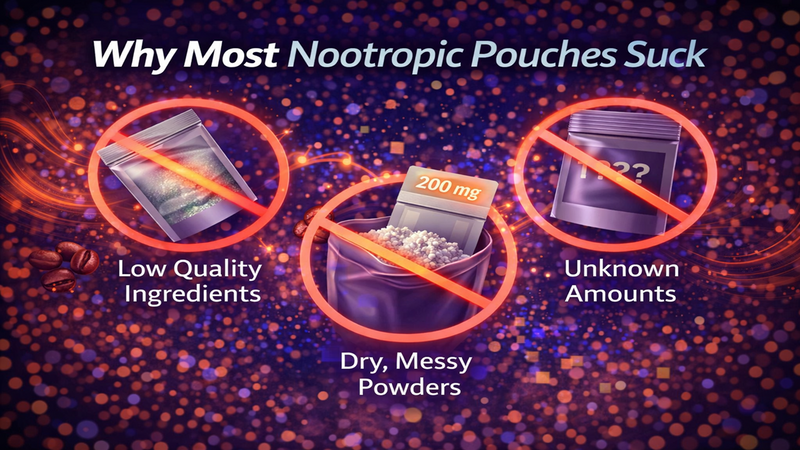
Why Most Nootropic Pouches Suck (And What to Actually Look For)
THE HYPE VS. REALITY GAP
The nootropic market is worth billions. That number keeps climbing. And somewhere between the clinical research and the checkout page, most of that money is being wasted.
Scroll your feed for ten minutes. You will find nootropic pouches promising sharper focus, better memory, less stress, and more output. The packaging looks serious. The marketing sounds credible. The claims are bold.
The products, more often than not, are garbage.
That is what happens when a profitable category attracts brands that care more about margin than formulation. Consumers pay premium prices for products that are underdosed, poorly sourced, and loaded with ingredients that have no business being in something marketed for your brain.
Here is how to see through it.
THE FAIRY DUSTING PROBLEM
This is the most common scam in the supplement world. Nootropics are no exception.
Fairy dusting is when a brand puts a clinically supported ingredient on the label. Something like Lion's Mane, L-Theanine, or Bacopa Monnieri. But in an amount so small it could not possibly do anything. They are not technically lying. The ingredient is in there. But 10mg of something that requires 300mg to have an effect is not a formula. It is a label strategy.
Why do brands do this? Because it is cheaper. And because most consumers see a recognizable ingredient name and assume it works.
Before you buy anything, look up the clinically studied dosage for every active ingredient in the product. Then compare that number to what is on the label. The gap between the two tells you everything you need to know.
PROPRIETARY BLENDS
Proprietary blends are when a brand groups multiple ingredients under a single name. "Cognitive Support Complex." "Focus Matrix." They list a total weight for the group but do not disclose how much of each individual ingredient is actually in there.
The brand will tell you this protects their formula from competitors. That is partly true. It is also a convenient way to hide that the expensive, effective ingredients are present in trace amounts while cheap filler makes up the bulk.
If a brand will not show you exactly how much of each ingredient is in their product, that is a red flag. Full stop. Transparent labeling is not a bonus feature. It is the baseline expectation for any brand that actually stands behind its formula.
INGREDIENT QUALITY AND SOURCING
Not all forms of an ingredient perform the same way. This is where most people get tripped up.
Take Vitamin B12. The cheap form is cyanocobalamin. The premium, bioavailable form is methylcobalamin. Your body absorbs and uses these two forms very differently. The same principle applies to magnesium, folate, and a dozen other common nootropic ingredients.
Brands using inferior ingredient forms are not always being malicious. They are cutting costs. But the consumer pays for it, both at checkout and in the form of a product that does not perform the way it should.
When evaluating any product, look for specific ingredient forms on the label. If it just says "Vitamin B12" without specifying the form, that is worth questioning. If it says "Methylcobalamin," that is a brand paying attention to what they are actually putting in their formula. This is basic the same issue the energy drink market suffers from.
SUGAR AND ARTIFICIAL SWEETENERS IN A BRAIN PRODUCT
Here is the part that should genuinely irritate you.
A product marketed as cognitive support. Something you are taking specifically because you care about your brain. And it contains aspartame, sucralose, or straight sugar. A lot of nootropic pouches do.
The gut-brain connection is real and well-documented. What disrupts your gut affects your cognition. Artificial sweeteners can alter the gut microbiome, contribute to inflammation, and for some people, produce exactly the brain fog the nootropic is supposed to clear.
Watch for these on labels:
- Sucralose
- Aspartame
- Acesulfame Potassium (Ace-K)
- Maltodextrin
- High Fructose Corn Syrup
Why do brands add them? Two reasons. First, taste-masking. If your base ingredients taste bad, and many do, sweeteners make the product palatable without fixing the underlying formula problem. Second, they are cheap. Far cheaper than building a formula that tastes clean without shortcuts.
A product that genuinely cares about what it does to your brain should care about every ingredient in it. Including the ones that are not doing any cognitive work.
TOO MUCH CAFFEINE, NOT ENOUGH COGNITION
A lot of products sold as nootropic pouches are, under closer inspection, caffeine delivery systems with a few extra names on the label.
High-dose caffeine creates a sensation of alertness. It works in the short term. But it also creates dependency, crashes, and for a lot of people, anxiety, jitteriness, and a sharp performance drop a few hours in.
Real nootropic support goes further than stimulation. L-Theanine paired with caffeine smooths the effect and extends the focus window. Adaptogens like Siberian Ginseng support stress resilience over time. CoQ10 and PQQ support cellular energy production at a deeper level. B vitamins support cognitive metabolism.
If the product you are looking at has 200mg of caffeine and a handful of low-dose additions to justify the nootropic label, it is not a nootropic. It is a stimulant with better branding.
Look at the full formula. Ask whether what is in the product actually supports cognition, or just makes you feel temporarily wired.
VAGUE CLAIMS
The FDA prohibits dietary supplements from making specific health claims. Brands cannot legally say their product treats, cures, or prevents any condition. That is a reasonable regulation. What it produces is an industry full of language designed to imply exactly that without ever saying it directly.
You will see phrases like:
- "Supports mental clarity."
- "May promote focus."
- "Helps with occasional stress."
- "Designed to optimize cognitive performance."
These phrases are legally safe. They are also often completely meaningless. They do not tell you what the product does, how much of it works, or what evidence supports any of it.
This does not mean every brand using this language is being dishonest. Under current regulations, some of it is unavoidable. But the better brands are specific. They tell you what ingredients are in the product, at what doses, and what the research says about those doses. They let the formula speak for itself.
Vague claims paired with underdosed or hidden ingredients. That is the combination to watch for.
BAD TASTE AND POOR USER EXPERIENCE
This one gets overlooked because it sounds like a minor complaint. It is not.
If a product is unpleasant to use, bad taste, uncomfortable texture, rough after-effects, people stop using it. Consistency is where nootropic benefits build over time. A product you will not stick with is a product that does not work, regardless of what the formula looks like on paper.
Bad taste is also frequently a signal. Poor ingredient quality, bitterness from underdosed extracts, or artificial sweetener overload to cover for a formula that does not taste clean on its own. A well-formulated product in a well-designed delivery format does not need to fight against itself. Natural flavors go a long way in making a product taste much better.
WHAT TO ACTUALLY LOOK FOR IN NOOTROPOIC POUCHES
Here is the checklist. Use it on any nootropic pouch before you spend your money.
Transparent labeling. Every ingredient listed individually with exact dosages. No proprietary blends. No hiding behind "complex" or "matrix" language.
Clinically dosed ingredients. Compare what is in the product to what the research shows is an effective dose. If there is a significant gap, move on.
High-quality ingredient forms. Look for methylcobalamin over cyanocobalamin, methylfolate (5-MTHF) over folic acid, and bioavailable forms across the board. If a label lists the ingredient name without specifying the form, ask why.
No artificial sweeteners or sugar. Sucralose, aspartame, Ace-K, and maltodextrin do not belong in a product you are taking for cognitive benefit. If the formula requires heavy taste-masking, the formula has a problem.
Balanced stimulant levels. If caffeine is present, it should be paired with something like L-Theanine to manage the effect. High-dose caffeine alone is a stimulant, not a nootropic.
Honest claims. The brand should be able to tell you what the research says about their specific ingredients at their specific doses. Generic wellness language is a placeholder for substance they do not have.
You actually want to use it. Taste matters. User experience matters. A product that works on paper but fails in daily practice still fails.
The nootropic category has real science behind it. There are ingredients with genuine, well-studied cognitive benefits. The problem is not the category. It is the brands treating formulation as a marketing exercise.
The bar for what deserves your money is higher than most products currently clear.
See how Flowblend's SPEAR nootropic pouches stack up.
That is exactly the bar SPEAR was built to clear. Transparent labeling. Clinically dosed ingredients. No artificial sweeteners. No proprietary blends. Every ingredient disclosed, every form specified, crafted in small batches in Montana because the formula matters too much to cut corners on production.
If you have read this far, you already know what to look for.
