
Ingredients In Nootropics You Should Look For Before Buying
Key Takeaways
- Look for core ingredients like Alpha GPC for choline support, UMP-5 for brain cell health, Rhodiola Rosea for stress resilience, and L-Theanine for calm focus. These provide a great foundation for memory, clarity and mental endurance.
- Search for intelligent blends, not individual “superstar” components. This is why pairing elements like L-Theanine with stimulants or Rhodiola with choline sources can really increase effects while mitigating jitters and crashes.
- Take a close look at supplement facts. Actually check the purity, standardization, and milligrams per serving. See through cheap fillers, secret blends, and underdosed formulas. Check every active and inactive ingredient.
- Know the natural versus synthetic source trade-offs. Don’t just take it at face value, either. Compare bioavailability and consistency, check for extra plant compounds, and make sure the label specifies which form is used.
- Think months, not days, when it comes to brain performance. Use safe, well-dosed ingredients consistently and track focus, mood, and productivity over time to see if a formula really deserves a spot in your regimen.
- Employ a hard vetting checklist prior to purchase. Focus on third-party tested products, transparent labels, and clinically aligned ingredient dosages. Eliminate anything with sketchy proprietary blends or fillers.
These are the types of ingredients in nootropics you should look for: ones that support real, sustainable cognitive performance, not just a temporary spike in alertness. Typical examples are molecules that support mitochondrial energy, stress resilience, blood flow, and neurotransmitter balance. Research tends to focus on ingredients such as citicoline, L-theanine, rhodiola, and bacopa for these functions. We next break down the details to see how they really fit into a long-term performance system.
Flowblend Spear Is Packed With The Best Nootropics:
Need Nootropics With An Energy boost? Use Stoked:
The Core Ingredients In Nootropics That Work
Core nootropics should work like solid training basics: reliable, scalable, and low drama. No wild spikes or mystery blends exist, and nothing swaps tomorrow’s clarity for today’s buzz.
Alpha GPC and Choline Support
Alpha GPC is easily the best choline source. Choline provides acetylcholine, a critical neurotransmitter for memory, learning, and motor control. In practical terms, this means better recall under pressure, a cleaner mind–muscle connection, and less “word searching” when tired. Relative to common choline salts, Alpha GPC crosses the blood–brain barrier more effectively, so smaller doses still make an impact.
Citicoline is in the same discussion. It donates choline and supports phospholipids—the good-for-you fats that comprise brain cell membranes. Given that the brain is approximately 60% fat, membrane integrity is important for long-term cognitive durability, not just short bursts of attention. Citicoline has demonstrated value in cognitive impairments such as vascular dementia and post-stroke decline, which points to genuine, structural support rather than surface stimulation.
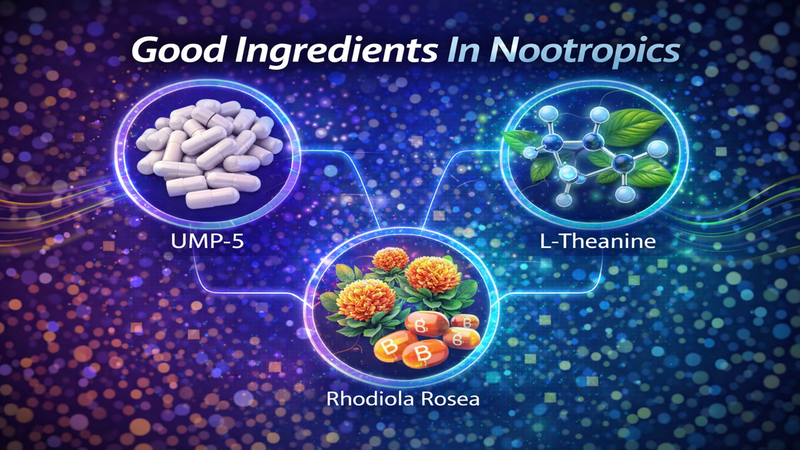
UMP-5 (Uridine Monophosphate)
Uridine Monophosphate operates a bit further upstream, assisting in the construction and repair of brain cell membranes and synapses. Think of it as wiring material, not a stimulant. By supporting phosphatidylcholine synthesis and synaptic plasticity, UMP-5 can help with learning, mental flexibility, and long-term cognitive resilience.
Stacking UMP-5 with strong choline sources and DHA from diet or fish oil creates a simple “brain infrastructure” system: choline plus uridine plus omega-3s. Over time, this promotes smoother thinking during long work blocks, less brain burnout between meetings, and improved absorption of new skills or training concepts.
Underneath all of this are B Vitamins, particularly B6, B9, and B12. They fuel methylation, neurotransmitter synthesis, and energy metabolism. Low levels are associated with brain impairment and elevated homocysteine, something connected to brain aging. A good formula contains significant, not token, doses of these Bs.
Rhodiola Rosea
Rhodiola Rosea, an adaptogen, means it helps your body manage stress more effectively rather than cover it up. For most high-responsibility professionals, the bottleneck isn’t intensity; it’s staying sharp when stress stacks—deadlines, training, lousy sleep, and family load all at once.
Rhodiola has the data to support calm alertness in stressful environments. Many people feel it within about 30 minutes, with effects lasting up to 6 hours. This includes less mental fatigue, better task switching, and fewer “I’m done” moments mid-afternoon. It complements N-Acetyl L-Tyrosine, which bolsters dopamine and cognition under duress and multi-tasking. Together, they fit days that resemble heavy compound lifts for your nervous system with multiple requests and nowhere for sloppy decision making.
This is stress resilience, not a license to overreach. Rhodiola can help you maintain your standard on hard days, but it doesn’t substitute for sleep, deloads, or boundaries.
L-Theanine
L-Theanine is one of the most elegant tools for calm focus. It boosts alpha brain waves, the rhythms associated with tranquil focus, engaged but not jittery. A 50 mg dose is about what you’d obtain from approximately 400 ml of black tea, without the extra bulk or inconsistency.
The magic happens when you combine L-Theanine with caffeine. This means instead of the classic jitter-crash curve, you experience smoother stimulation, fewer heart palpitations, and less anxious looping. For someone who already tracks sleep and recovery, this matters: less nervous system overdrive, better evening wind-down, and fewer nights sacrificed to one strong coffee.
L-Theanine doesn’t flatten you like a sedative. It filters out noise. Meetings seem less reactive, hard sets seem more intentional, and deep work blocks become easier to defend.
Bacopa Monnieri sits close to Theanine in the ‘calm cognition’ track. It’s a long game player. It’s been shown to power higher-order cognitive processes, transforming new information into stable learning and memory. Results are incremental and gradual. You tend to glance back after 6 to 12 weeks and observe enhanced memory from books, classes, or technical work.
Maritime Pine Bark Extract contributes vascular support. It enhances cerebral blood flow and provides antioxidant support. It is brain “anti-aging”—clearer thinking at long time horizons, not overnight transformation.
Why Ingredient Synergy Matters In Nootropics
Ingredient synergy is not about how ingredients interact on your label. It’s about how compounds interact in your system. For the serious trainee interested in recovery and long-term output, that interaction is more important than any individual “hero” ingredient.
By combining Alpha GPC, UMP-5, Rhodiola rosea, and L-theanine, you can address multiple layers of cognitive optimizations simultaneously. Alpha GPC supports acetylcholine and focus. UMP-5 (uridine monophosphate) feeds into membrane and neurotransmitter signaling. Rhodiola aids stress response and mental exhaustion. L-theanine smooths the experience, reducing jitter and mental noise. Combined, you receive purer focus, more effective stress management, and a reduction of the wired-tired crash you observe with potent stimulants by themselves.
L-theanine is a great example of one ingredient balancing another. Combined with caffeine, it can maintain alertness while minimizing jitters, heart rate spikes, and that impatient, restless feeling. That same idea applies across nutrition: some nutrients enhance or block others. Calcium can inhibit iron absorption. Fat-soluble compounds frequently require a delivery system, like liposomes, in order to be absorbed well at all. This is why advanced delivery systems can be such an asset for lipophilic nootropic actives.
Synergy shows up in broader health areas tied to cognition: immunity, infection resistance, and malnutrition. Bad nutrient synergy can dull immune function or stress recovery, which then takes a toll on focus and training quality. The objective is a stack that supports the entire system, not a raucous ingredient that hijacks the spotlight.
- Alpha GPC and UMP-5 complement choline signaling and provide membrane support for sustained focus.
- Rhodiola and L-theanine provide stress control and calm alertness with fewer side effects.
- Caffeine and L-theanine lead to sharper attention with less jitter and crash.
- Fat-soluble nootropics and advanced delivery lead to better absorption and lower required doses.
There is some obligation on manufacturers here. They must engineer for synergy, not buzz-shelf-marketing, and describe why ingredients are combined instead of merely enumerating them. Haphazard mixing and dose-splitting is guesswork, not formulation.
Not every ingredient should be combined. Others diminish impact or cause the exact issues you’re attempting to circumvent, such as sleep interference, blood pressure spikes, or an over-suppressed appetite in a triathlete already on a grueling training schedule. Smart pairing can minimize side effects compared to a single high-dose ingredient alone, delivering usable energy and focus you can repeat day after day.
Decoding the Supplement Label
Reading a nootropic label is about seeing through the marketing and into the system underneath: what you are actually putting into your body, at what dose, and in what form.
Start with basics: ingredient name, dose, and percentage of daily value (DV) for each nutrient. If a label says “Vitamin B3” with no form listed (niacin, niacinamide, inositol hexanicotinate), that’s a red flag. The same applies to ‘magnesium’ with no type. In such instances, either reach out to customer service or walk away. You’re purchasing transparency, not intrigue.
Purity and standardization are important. For choline, you may see ‘Alpha GPC (99% pure)’ versus a non-specific ‘choline complex’. For botanicals, look for standardized extracts: “Rhodiola rosea extract, standardized to 3% rosavins, 1% salidrosides,” or “Ashwagandha extract, 5% withanolides.” That informs you of the active fraction, not just the botanical name.
Know exactly what dosages per serving of these key nutrients are, then see serving size and servings per container. A label can look robust at first glance but can conceal underdosed ingredients in a three-capsule serving or tout benefits from micro-doses of key actives.
Scan both active and inactive ingredients carefully:
- Active nootropic compounds
- Standardized plant extracts with ratios (e.g., 10:1)
- Forms of vitamins/minerals (e.g., magnesium glycinate)
- Capsule materials (e.g., cellulose, gelatin)
- Fillers and flow agents (e.g., magnesium stearate, silica)
- Sweeteners, flavors, colors, or unnecessary additives
Cross-reference label claims with ingredient forms. L-tyrosine” (amino acid) acts differently than an ambiguous “herbal focus blend.” Bioavailability can shift with form: a well-standardized extract often hits more reliably than powdered whole herb, but megadoses—especially of stimulants or B-vitamins—can push imbalance instead of performance. Watch plant-to-extract ratios; a 10:1 extract is not the same as simple “root powder.
Natural Versus Synthetic Sources
Natural nootropics and synthetic nootropics both fall under the same category. They act differently in your body and have different long-term use tradeoffs.
Natural nootropics are derived from plants and herbs. Consider Ginkgo biloba for circulation and Bacopa monnieri for memory and stress assistance. They typically come as root, leaf, or whole-plant preparations, which is to say you’re not just receiving a single “active” molecule. You’re getting a mix of supporting compounds—flavonoids, tannins, and other phytonutrients—that can help smooth out the effect, improving tolerance. These ingredients have centuries of traditional use along with contemporary evidence demonstrating that they are typically safe and well-tolerated by the majority of users. Long-term use in elderly adults with memory complaints has failed to prevent progression to Alzheimer’s disease. Useful, yes. Magic, nah.
Synthetic nootropics such as modafinil and Adderall are engineered to target particular neurochemical pathways. They’re more focused, more sensational and more urgent. Modafinil, for example, can dramatically boost wakefulness, attention and executive function. These compounds are more closely examined in controlled trials. The tradeoff is risk: side effects, dependence, and in some cases addiction potential. For a busy professional or athlete trying to train, work and sleep on schedule, that volatility matters more than the short-term upside.
Absorption and bioavailability is what sits in the middle of this choice. Others, such as standardized Bacopa extracts, absorb well and accumulate effects over weeks. Certain synthetic forms are created for extremely high bioavailability, which is why you experience them so quickly. More absorption isn’t always better if the effect is too jarring.
On labels, look for clear wording:
- Pros of natural: broader plant compounds, long history of use, usually gentler, often safer for steady daily stacking.
- Cons of natural: slower onset, less dramatic effect, and quality varies by source.
- Pros of synthetic: strong, predictable acute effects, tight mechanism, often well studied.
- Cons of synthetic include a higher risk of side effects, addiction potential, and more stress on sleep and recovery.
The Long-Term Brain Game
Long-term brain performance is built the same way long-term strength is built: steady inputs, consistent stress, and controlled recovery. Nootropics worth your time fit that mold.

A coherent stack is taken daily and evaluated over 2–3 weeks, not 20 minutes. Many of the better-studied ingredients were first used in clinical settings: nootropics showed up in trials in the 1970s for Alzheimer’s disease, ADHD, stroke, and age-related decline. That tells you how they’re supposed to work: slow, foundational, and cumulative.
Choline-inspired ingredients are a good example. Observational studies connect greater choline consumption to improved cognition. Citicoline has benefited vascular dementia and post-stroke decline. Phosphatidylcholine boosted brain acetylcholine and memory in dementia-model mice. Those are the kinds of signals you want: support for cell membranes, neurotransmitter balance, and long-range brain health, not a flashy buzz.
Herbal ingredients can play the identical lengthy game. Bacopa monnieri is a centuries-old Ayurveda herb for memory and mental balance. It usually requires weeks of consistent use before you observe sharper memory or steadier attention. Rhodiola rosea has data in real-world stress. One study found less mental fatigue in 56 night-shift physicians after two weeks of low-dose use. Again, no fireworks—just less drain under pressure.
On the more targeted side, huperzine A has a systematic review behind it: across 20 randomized controlled trials, it improved cognitive function and daily living in people with Alzheimer’s. That doesn’t mean we all need it, or that more is better. It does mean serious ingredients are typically tried for protection and everyday consumption, not weekend experiments.
Track your own response over weeks: focus, mood stability, recall, sleep quality, training consistency. If a stack requires increasingly more stimulation, it is flunking the long-term test.
My Personal Vetting Process
I treat nootropics the same way I treat training cycles: structured, repeatable, and hard to game.
Before buying anything, I run ingredients through a simple checklist:
Does this ingredient have any human data, not just cell or animal studies?
Is the form and dose consistent with research or are you taking a bargain-basement version?
Are extract ratios and active compounds clear? For example, is Rhodiola standardized for rosavins and salidroside, not just “Rhodiola 10:1”?
Do they contain red flags such as ‘boosts IQ by 30 points’ or ‘cures brain fog permanently’? New impossible promises tend to indicate feeble fundamentals.
Is the portion size truthful? If it reads ‘1,000 mg per serving’ and a serving is 4 capsules, I assume they desire obfuscation, not transparency.
Anything that fails one of those points is out.
I require transparent sourcing and third-party testing. In-house testing is great as a starting point, but that is not the same as independent validation. I seek out COAs from accredited labs demonstrating identity, potency, and contaminants such as lead, mercury, and arsenic. If a brand won’t provide recent COAs, I assume the worst and move on. USP Verified or Informed Sport/Informed Choice certifications are good signs that the maker knows how to do quality control and is open to inspection.
For real ingredients, I prefer clinically realistic doses of a handful of workhorses. Alpha GPC in the 300 to 600 mg per day range, not 50 mg sprinkled in. UMP-5 (uridine monophosphate) at research-level doses, specified in milligrams. Rhodiola Rosea with a clear standardized extract, and L-Theanine at 100 to 200 mg, particularly if caffeine is part of the mix. I bypass fancy formulas masquerading with proprietary blends, artificial colors, and junk fillers. If I can’t see exact amounts per capsule and per serving, it doesn’t get close to my daily stack.
Conclusion
Powerful nootropics don’t begin with witty packaging. They begin with clean inputs, transparent dosing, and a defined role in your broader system.
The pattern stays the same:
- Proven core ingredients in effective ranges
- Synergy instead of ingredient noise
- Labels you can actually verify
- Forms your body can absorb and use
- A track record of safe, long-term use
From there, the filter becomes personal: training load, work demands, sleep and tolerance.
Nootropics function optimally as a complement to habits you already possess—exercise, diet, rest, and stress management. When those are steady, the right stack does not flip a switch. It lifts your floor and holds it up.
Frequently Asked Questions
What are the most important nootropic ingredients to look for?
Focus on well-studied ingredients: citicoline (CDP-choline), L-theanine, caffeine, bacopa monnieri, rhodiola rosea, lion’s mane mushroom, and omega-3s (DHA). These have human research behind them for memory, focus, mood, or mental energy.
How do nootropic ingredient combinations improve results?
Certain ingredients complement each other. For instance, caffeine and L-theanine can increase alertness while smoothing out jitters. Choline sources can enhance certain racetams. Search for synergy-based formulas, not random ingredients 'kitchen sinks'.
How can I quickly read a nootropic supplement label?
Check three things: exact doses, not “proprietary blends”; standardized extracts, such as bacopa with stated bacoside content; and third-party testing or certifications. Avoid under-dosed formulas and nootropics that hide ingredient amounts.
Are natural nootropic ingredients safer than synthetic ones?
Natural” doesn’t always mean safer, and “synthetic” doesn’t always mean dangerous. Safety is a function of dose, purity, and your health. Look for ingredients with human studies, clean manufacturing, and clear labeling, whether natural or synthetic.
Which nootropic ingredients are best for long-term brain health?
Look for ingredients with neuroprotective data: omega-3 DHA, citicoline, phosphatidylserine, bacopa monnieri, and lion’s mane mushroom. These are researched for sustaining memory, brain architecture, and robustness over months, not rapid stimulation.
What red flags should I watch for when vetting nootropic ingredients?
Watch out for massive proprietary blends, ridiculous claims, such as "magic pill," no third-party testing, and formulas loaded with stimulants. Extremely high doses with no scientific justification are another red flag. When in doubt, look up each separate ingredient.
Can I stack multiple nootropics safely?
Occasionally, begin with a low dose and introduce one substance at a time. Track sleep, mood, heart rate, and digestion. Look for redundant stimulants or mechanisms. For medical conditions or medications, consult a healthcare professional first.
Additional Topics: