
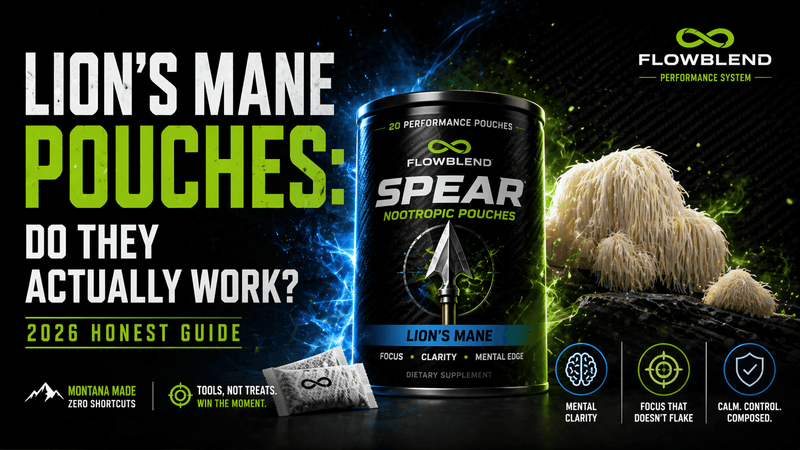
Lion's Mane Pouches: Cognitive Myth, Cognitive Tool, or Both?
By Nate, Founder of FlowBlend — Kalispell, Montana · Last updated April 2026 · 10 min read
Lion's mane is the most hyped mushroom on earth right now. Every nootropic listicle leads with it. Every wellness influencer name-drops it. Every new functional mushroom product — pouches, gummies, coffee creamers, RTD drinks — anchors around lion's mane because the name sells.
Most of the hype is earned. Lion's mane is one of the few functional mushrooms with a real mechanism, real clinical trials, and real cognitive benefits for people who take it properly.
The word "properly" is doing a lot of work in that sentence.
This article is the honest breakdown. What lion's mane actually does in your brain. What the research says at what dose. What a lion's mane pouch actually delivers. And if focus is really what you're after — when a different mechanism entirely does the job faster.
I'm Nate. I run FlowBlend out of Kalispell, Montana. I don't make lion's mane pouches. I make nootropic pouches built on Alpha-GPC — a different cognitive mechanism that actually fits the pouch format. So I have no skin in the game selling you lion's mane. What I can do is tell you the truth about it.
What Lion's Mane Actually Does
Lion's mane (Hericium erinaceus) is a white, shaggy mushroom that grows on hardwood trees. It looks nothing like a button mushroom. It looks like a dense cluster of icicles or — you guessed it — a lion's mane.
It's been used in traditional East Asian medicine for centuries. What makes it interesting to modern researchers is two families of compounds:
- Hericenones — found in the fruiting body (the above-ground mushroom you'd recognize).
- Erinacines — found in the mycelium (the underground root-like network).

Both compounds can cross the blood-brain barrier. Once inside, preclinical studies suggest they may stimulate the production of Nerve Growth Factor — a protein your brain uses to grow, maintain, and repair neurons. That's the mechanism every cognitive claim about lion's mane rides on.
If that sounds impressive, it should. Most supplements claiming to "boost brain health" have no mechanism to point to. Lion's mane has one, and it's been studied in real humans.
What the Research Actually Says
This is where lion's mane earns its stripes.
A 2024 systematic review in Nutrients pulled together 12 randomized controlled trials on lion's mane supplementation. The headline finding: adults aged 50–80 taking lion's mane at doses between 1,000 and 3,000 mg per day showed an average 15% improvement in cognitive scores over 8 to 16 weeks. That's not a placebo-sized effect. That's meaningful.
Other findings from the broader research body:
- Improvements in mild cognitive impairment after 16 weeks at 3 g daily.
- Reductions in self-reported anxiety and depression scores in small studies.
- Possible support for peripheral nerve recovery.
- Signs of reduced mental fatigue in chronic-fatigue populations.
The research isn't bulletproof — most studies are small, and the healthy-young-adult data is thinner than the aging-adult data. But the signal is real. Lion's mane does something measurable in the brain when taken at research dose for research duration.
Read that sentence again. At research dose. For research duration.
That's the hinge the whole pouch conversation turns on.
What's in a Lion's Mane Pouch
Now the math.
The leading lion's mane pouch on the market — Flow Pouches — advertises 600 mg of total mushroom extract per can. One can contains 20 pouches. That extract is split across three mushrooms: lion's mane, cordyceps, and reishi.
Do the math and you land somewhere around 10 mg of lion's mane per pouch. Generous estimate: 20 mg if it's the headliner in the blend. At the recommended 4–6 pouches per day, you're getting 40–120 mg of lion's mane daily.
Stack that against the research:
You would need to chew through 2.5 cans in a single day to hit the research minimum for a one dose. That's not how anyone uses pouches.
This isn't a knock on the format. It's physics. Lion's mane extract is bulky. To get a cognitive-range dose into a pouch, you'd either need a pouch the size of a ravioli or extract so concentrated it'd cost $500 per can. Neither exists.
One other thing the pouch conversation skips: fruiting body vs. mycelium.
Most of the strongest research uses fruiting body extract. That's where hericenones are concentrated. Mycelium-on-grain products — common in cheaper supplements — are mostly the grain substrate with a thin layer of mycelium, and contain very little actual compound. Lion's mane pouches rarely disclose which form they use. When a label doesn't say, assume the worse option.
(For the full side-by-side on every mushroom-in-a-pouch, see our mushroom pouches complete guide.)

Two Roads to Focus: The Mechanism Difference
Here's what nobody explains clearly.
When someone says they want "focus," they usually mean one of two different things:
- Long-arc cognitive health — protect the brain over months and years. Build better neural connections. Support aging.
- In-the-moment mental sharpness — crush a 90-minute deep-work block that starts in 20 minutes. Stay clear during a presentation. Get through a long drive without brain fog.
These are different problems. They need different tools. They run on different biochemistry.
Lion's mane works on Nerve Growth Factor (NGF). NGF is a long-timeframe signal — your brain uses it to grow, maintain, and wire neurons. Think of it like feeding your lawn. You fertilize in spring, you mow in summer. The grass is thicker in August because of what you did in April. Lion's mane works the same way. You won't feel it today. You might feel it after 12 weeks of consistent dosing.
Alpha-GPC — the nootropic inside SPEAR — works on acetylcholine. Acetylcholine is a neurotransmitter your brain uses in the moment to power attention, working memory, and sharp thinking. Alpha-GPC is a choline source that crosses the blood-brain barrier quickly and gives your brain the raw material to make more acetylcholine right now. Think of it like putting gas in the tank. You don't plant a tree. You drive.
Here's the side-by-side:
Two valid tools. Two different jobs. One fits the pouch format. One doesn't.
This is where the whole "lion's mane pouch" category falls apart. People buy them expecting in-the-moment sharpness, because that's what the marketing suggests. They get neither same-day sharpness (wrong mechanism) nor long-arc cognitive support (wrong dose). They land in the gap between the two — which is exactly where ritual lives, and exactly why a pouch can't be a performance tool in this category.
Most competitors dose Alpha-GPC at 40 mg, because it's cheaper. We use 150 mg in SPEAR because that's the clinical range. Potency is the point.

When Lion's Mane Wins, When SPEAR Wins
Honest answer by goal.
Go with lion's mane if:
- You want long-arc cognitive support and you're willing to commit to daily dosing for 8–16 weeks before you evaluate.
- You're thinking about aging, neuroprotection, mild cognitive decline, or long-term brain health.
- You're going to take a concentrated capsule at 1,000+ mg per day. Not a pouch.
- You don't need to feel it today. You need it to be working in the background, quietly, over time.
At research dose, lion's mane is one of the most interesting cognitive tools on the supplement shelf. Respect the molecule. Just don't ask it to do something it can't do — fit in a pouch at effective dose, or hit fast.
Go with SPEAR if:
- You want focus you can feel within an hour. Deep work blocks. Meetings that matter. Morning clarity.
- You want a measured, clinical-range dose — not a ritual with a label.
- You want the pouch format — clean, portable, no crash, no caffeine spike, works on demand.
- You want a stack built by a craft pouch company in Montana, third-party tested, with every milligram on the label.
SPEAR runs on 150 mg Alpha-GPC at clinical range, plus Rhodiola rosea for composure under pressure, L-theanine for smooth edges, and uridine monophosphate to keep mental drive engaged. No caffeine. No crash. Built for the exact moment mushroom pouches can't touch — the one where you need to perform now.
Both tools can be true. Take lion's mane daily in capsule form for long-arc protection. Keep SPEAR in your pocket for the moments that need sharpness on demand. Different mission, different equipment.
If the job is "focus I can feel today," you want SPEAR. Everything below is how to use it.
Stay Sharp


Frequently Asked Questions
Do lion's mane pouches actually work?
At pouch-format dose, not in any meaningful cognitive sense. You'd need 15–20 pouches per day to hit the research-validated dose for lion's mane (1,000+ mg). What a lion's mane pouch does deliver is oral ritual, flavor, and placebo — which aren't worthless, but aren't the cognitive intervention the marketing suggests.
How much lion's mane is in a pouch?
Most brands don't disclose per-ingredient mg. When you back-calculate from total extract claims, you're looking at roughly 10–20 mg of lion's mane per pouch. At 4–6 pouches per day, that's 40–120 mg daily — about 4–12% of the dose used in clinical research.
How long until lion's mane works?
At research dose (1,000–3,000 mg/day of concentrated fruiting body extract), most studies show measurable cognitive effects around 8–16 weeks of consistent daily use. Lion's mane is a long-arc tool. If you're looking for same-day focus, you want a different mechanism entirely.
Is Alpha-GPC better than lion's mane for focus?
Better for what. Alpha-GPC works on acetylcholine — the neurotransmitter your brain uses in the moment — so it hits in 30–60 minutes. Lion's mane works on Nerve Growth Factor — the protein that builds and maintains neurons over time — so it takes 8–16 weeks. For same-day sharpness, Alpha-GPC is the right mechanism. For long-arc cognitive protection, lion's mane is. They're not competing.
Are lion's mane pouches safe?
Generally yes, for healthy adults. Lion's mane has a long safety record. The concerns with pouches come from sourcing — some brands use cheap overseas mycelium-on-grain extract with unknown heavy metal testing. If the brand won't show a COA (certificate of analysis), that's the tell.
Fruiting body vs. mycelium — does it matter?
Yes. Most of the research on lion's mane uses fruiting body extract, where hericenones are concentrated. Mycelium-on-grain products are usually mostly grain, with a thin layer of actual mycelium — much lower active compound content. If a label doesn't specify fruiting body, assume it's mycelium.
Can I take lion's mane and SPEAR together?
Yes. They do completely different jobs and don't interact problematically. Take a concentrated lion's mane capsule in the morning for long-arc cognitive support. Use SPEAR during the day when you need in-the-moment focus — before deep work, before a meeting, before a long drive. Two tools, different mechanisms, no conflict.
What's the best lion's mane product if I do want to try it?
Skip the pouches. Get a concentrated fruiting body capsule from a brand that discloses standardized beta-glucan content (≥20%), publishes a third-party COA, and specifies fruiting body on the label. Dose 1,000–2,000 mg per day. Take it consistently for 12 weeks before evaluating. That's the version that actually earned the research.
Does SPEAR contain lion's mane?
No. SPEAR is built on Alpha-GPC, Rhodiola rosea, L-theanine, and uridine monophosphate — a nootropic stack designed for same-day focus. Lion's mane is a different mechanism for a different job, and it doesn't fit the pouch format at effective dose. We use what works in the format we make.
The Bottom Line
Lion's mane is the real deal — at research dose, in capsule form, over a 12-week commitment. It's one of the few functional mushrooms with a mechanism worth respecting.
A lion's mane pouch is a different product. It's a ritual with a label, not a cognitive intervention. Nothing wrong with that if you know what you're buying. Plenty wrong with it if you bought it expecting focus.
If same-day sharpness is what you actually want — deep work, meetings, morning clarity — that's a different molecule entirely. Alpha-GPC at clinical range. Which fits the pouch format, hits in 30 minutes, and doesn't ask you to take 15 pouches a day to work.
That's SPEAR. Built in Montana. 150 mg Alpha-GPC. Every milligram on the label.
Win the moment.
About the Author
Nate is the founder of FlowBlend, a craft performance pouch company based in Kalispell, Montana. He started FlowBlend in 2020 after years of searching for a pouch that was neither a nicotine knockoff nor an underdosed placebo. FlowBlend makes CLUTCH (calm), CLUTCH 75 (high-potency calm), SPEAR (nootropic focus), and STOKED (clean energy) — all made in the United States, third-party tested, and transparently dosed.