
Mushroom Pouches
Do Mushroom Pouches Actually Work? A Dosing Reality Check
Nate, founder of FlowBlend
The Short Version
Whether mushroom pouches "work" is not a matter of opinion — it is arithmetic. Human mushroom research shows effects at 1,000–3,000+ mg of extract per day. A typical mushroom pouch carries about 30 mg, and even the brand's own maximum recommended use tops out around 180 mg a day — 6% to 18% of the research range, before splitting it across three mushrooms. We show every step of that math below so you can check it yourself. Then we show what a pouch with a working dose looks like.
What "Work" Has to Mean
Before any math, pin down the claim. "Work" can mean three different things, and mushroom pouch marketing slides between them constantly:
- Felt effect — you notice something within the hour. This is what most buyers expect.
- Research-backed effect — the outcome a study measured, at the dose the study used, over the weeks the study ran.
- Ritual effect — the pause, the habit replaced, the small psychological lift of doing something for yourself. Real, but available from any pouch, tea, or walk around the block.
Mushroom pouches reliably deliver number three. The marketing implies numbers one and two. The dose math below is about whether that implication survives contact with the published research. Spoiler from the rest of this cluster (the complete guide runs every mushroom): it does not.
What the Research Actually Used
These are the doses behind the studies the category cites — each one a real, verifiable publication we have walked through earlier in this series:
- Lion's mane: human cognitive studies used roughly 1,000–3,000 mg per day for weeks (full breakdown).
- Cordyceps: the strongest human exercise trial (Hirsch et al., 2017, Journal of Dietary Supplements) used 4,000 mg per day for three weeks (full breakdown).
- Reishi: the eight-week human fatigue study (Tang et al., 2005, Journal of Medicinal Food) used 5,400 mg of extract per day (full breakdown).
- Turkey tail: the Japanese clinical extract was dosed at about 3,000 mg per day under medical supervision (full breakdown).
Call the research range, conservatively, 1,000–3,000 mg of mushroom extract per day — taking the friendliest possible number for the pouch category (lion's mane's low end) as our benchmark.
Now the other side of the equation.
The Pouch Math, Step by Step
We will use the category's leading product as the worked example, without naming it (our rankings article names names; this one just runs numbers). Its label discloses:
- 600 mg of mushroom blend per can
- 20 pouches per can
- Suggested use: 4–6 pouches per day
Follow each step — this is grade-school division, which is exactly the point:
Step 1 — extract per pouch.
600 mg ÷ 20 pouches = 30 mg of mushroom blend per pouch.
Step 2 — daily intake at the brand's own maximum.
6 pouches × 30 mg = 180 mg per day.
(At the suggested minimum: 4 × 30 = 120 mg per day.)
Step 3 — compare to the research minimum.
1,000 mg ÷ 180 mg = 5.6 — the brand's heaviest suggested user gets one five-and-a-halfth of the lowest research dose.
As a percentage: 180 ÷ 1,000 = 18% of the research minimum. Against the 3,000 mg mid-range: 180 ÷ 3,000 = 6%.
Step 4 — now split the blend.
That 30 mg per pouch covers three mushrooms, so figure roughly 30 ÷ 3 = 10 mg of each mushroom per pouch. Lion's mane research minimum: 1,000 mg. 1,000 ÷ 10 = 100 pouches per day of lion's mane equivalence. At six pouches a day you get 6 × 10 = 60 mg — 6% of the minimum studied dose of the one mushroom you probably bought it for.
Step 5 — sanity-check with whole cans.
One can = 600 mg of blend. To reach 1,000 mg a day you would chew through 1,000 ÷ 600 = 1.7 cans per day. To reach the 3,000 mg mid-range: 3,000 ÷ 600 = 5 cans per day. Every day. For weeks, because that is how long the studies ran.
Even the most transparent pouch on the market — 233 mg of disclosed mushrooms per pouch, the best label we found — still needs 1,000 ÷ 233 = 4.3 pouches a day to scrape the research minimum, and that is total mushrooms, not any single one.
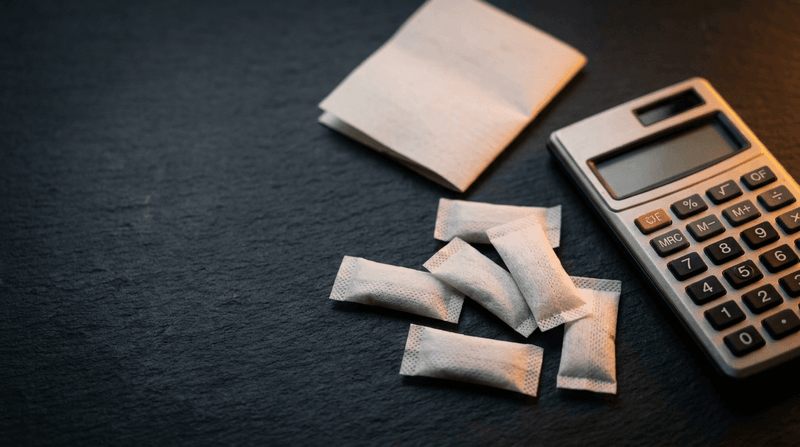
Check any line of this with the calculator on your phone. The brands are counting on you not to.
Built For Pressure

A Second Worked Example: The Best-Case Brand
Maybe you think we rigged the example by picking the leader's thin label. Fair. So let us run the math on the most transparent product in the entire category — the one that prints everything — and see if honesty alone closes the gap.
That brand discloses, per pouch: 100 mg lion's mane, 100 mg cordyceps, 33 mg chaga — 233 mg of named mushrooms, the best label on the market. Step through it:
Step 1 — the headline mushroom. Lion's mane research minimum: 1,000 mg/day. This pouch: 100 mg. 1,000 ÷ 100 = 10 pouches a day to reach the bottom of the studied range for lion's mane alone.
Step 2 — cordyceps. Strongest human trial: 4,000 mg/day. This pouch: 100 mg. 4,000 ÷ 100 = 40 pouches a day.
Step 3 — the whole can. 15 pouches × 100 mg lion's mane = 1,500 mg per can. So the entire can, chewed in one day, finally clears the lion's mane research minimum — once — at 15 pouches.
This is the best the category offers, and it still asks for 10 pouches a day for one mushroom and 40 for another. The transparency is genuinely admirable; the arithmetic is genuinely unchanged. Honesty does not raise the dose — it just lets you see how far short it falls. That is the whole point: the problem was never which brand. It is the format against the science.
The Absorption Argument, Examined
The category has one counterargument, so let us give it a fair hearing: "pouches absorb through the gum line, so they need less."
Buccal absorption is real — for the right molecules. Small, lipid-friendly compounds like nicotine and caffeine cross the oral lining efficiently; it is why nicotine pouches work at all. Cannabinoids do reasonably well by the same route.
But the mushroom compounds the research credits — beta-glucans and other polysaccharides — are large molecules. They are not slipping through your cheek in meaningful amounts; the research that exists on them runs through ordinary digestion. And even if you granted the gum line a generous edge — say it doubled or tripled effective delivery, which nothing published supports — you are bridging a 5x gap on the blend math and a 100x gap on the per-mushroom math. Absorption stories do not move decimal points that far.
A fair rule for any pouch label: absorption explains how an adequate dose gets in. It never explains an inadequate dose away.
What a Pouch Can Honestly Do
So do mushroom pouches do anything? Honestly — yes, two things.
The ritual works. The pause, the hand-to-mouth habit, the replacement of a worse tin. If a mushroom pouch is what finally retires a nicotine habit, it has earned its shelf space (that comparison here).
The placebo works — until it doesn't. Expecting to feel sharper genuinely makes some people feel sharper for a while. We are not sneering at that; placebo is the most reliable compound in the wellness industry. But placebo paid for at supplement prices, dressed in research citations the dose cannot cash, has a short shelf life — usually about as long as it takes the buyer to find the math you just read.
What a mushroom pouch cannot honestly do is the thing on the label: deliver the studied benefits of the mushroom at 6% of the studied dose.
What Working Actually Looks Like
Here is the same standard, pointed at our own cans. "Measured dose" is not a slogan — it is a pass/fail test any reader can run:
SPEAR — focus. 150 mg of Alpha-GPC per pouch, plus Rhodiola, L-Theanine, and Uridine Monophosphate, every milligram printed. Alpha-GPC is active at doses a pouch can actually hold — that is why we built on it instead of lion's mane in 2021, when we shipped the first nootropic pouch in America.
"There really is no buzz... It's not voodoo magic and it's not a stimulant. It just allows your brain to function a bit better." — Dillon Lehman, verified review
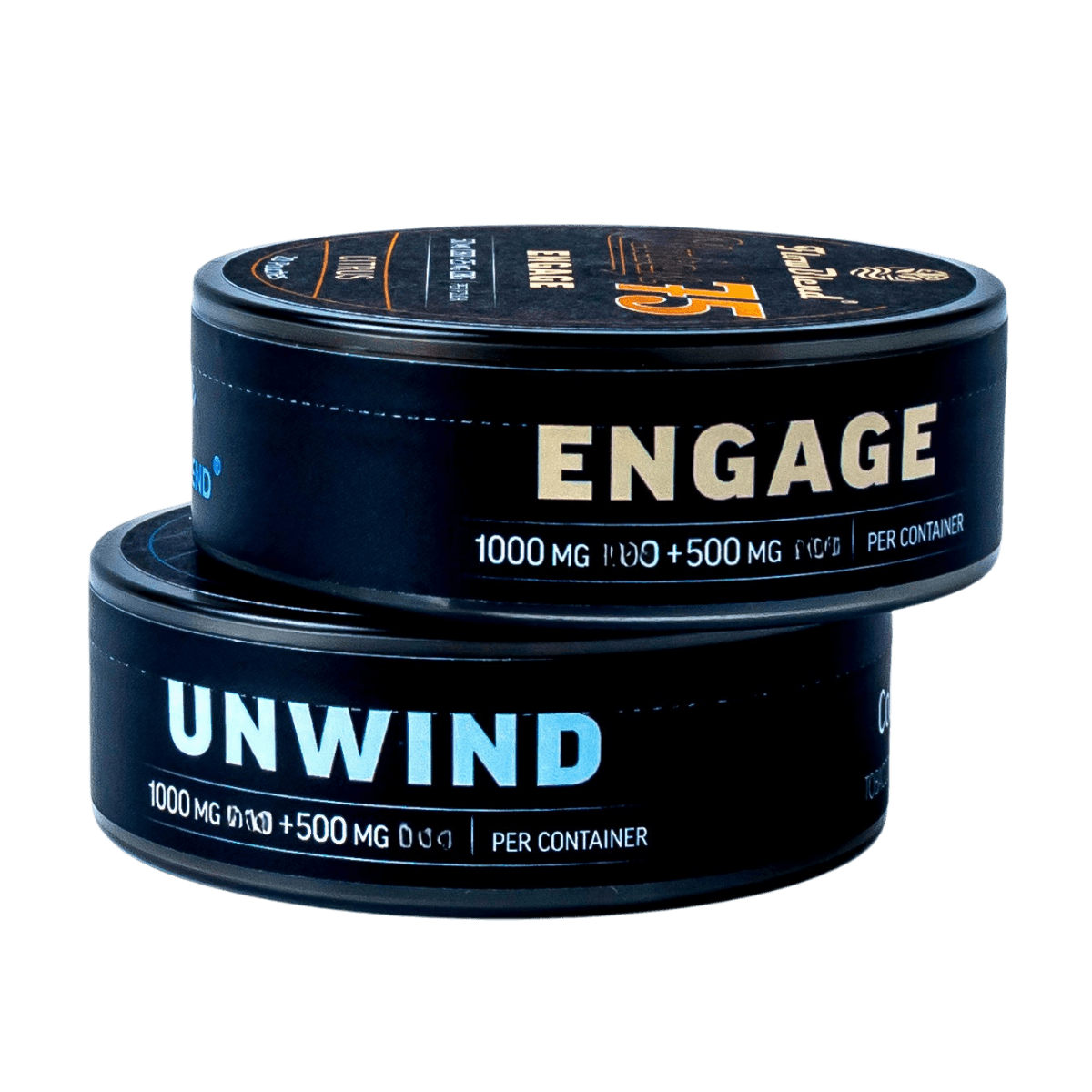
CLUTCH 75 — high-dose calm. 50 mg CBD plus 25 mg CBN (Unwind) or CBG (Engage) per pouch, third-party tested. Cannabinoids are felt in tens of milligrams; 75 mg of them fits in a pouch with the label to prove it.
Run the test yourself, on us: ingredient named, milligrams printed, dose inside the range the ingredient is actually used at. Any pouch that passes — ours or anyone's — is a tool. Any pouch that fails is a ritual with good fonts. The whole lineup is at flowblend.com/shop if you want to grade it.
FAQ
Do mushroom pouches actually work?
Not at the doses they contain. Human mushroom research shows effects at 1,000–3,000+ mg of extract daily; a typical pouch holds about 30 mg, and even six pouches a day delivers 180 mg — 6–18% of the research range across three mushrooms combined.
How many mushroom pouches would I need to match the research?
Using the category leader's label: 1,000 ÷ 30 = about 33 pouches a day to reach the lowest research dose — over a can and a half daily. For a single mushroom like lion's mane (about 10 mg per pouch), it is 100 pouches a day.
Don't pouches absorb better through the gums?
Buccal absorption helps small molecules like nicotine, caffeine, and cannabinoids. The mushroom compounds in the research — beta-glucans and other polysaccharides — are large molecules with no published evidence of meaningful oral-mucosa delivery. Absorption cannot close a 5x–100x dose gap.
Is the effect I feel from a mushroom pouch placebo?
At 30 mg against gram-level research doses, expectation is doing the heavy lifting — plus the genuine value of the ritual itself. Both are real experiences; neither is the studied effect of the mushroom.
What pouch ingredients work at real pouch doses?
Caffeine (30–100 mg), cannabinoids like CBD, CBN, and CBG (10–75 mg), and Alpha-GPC (150 mg). That dose-fit principle is why FlowBlend builds with these instead of mushrooms — every milligram printed on the can.
Related Reading
- Mushroom Pouches: The Complete 2026 Guide — the pillar guide to the whole category
- Lion's Mane Pouches: Do They Actually Work? — this same math, applied to the focus mushroom
- Best Mushroom Pouches of 2026: Honest Rankings — the rankings that name names
Nate is the founder of FlowBlend.