
Alpha GPC In Food: A Guide to Rich Natural Sources
Key Takeaways
- Beans, nuts, and whole grains are good vegan sources of choline, a nutrient necessary for brain health.
- Adding a mix of choline-dense foods to your routine throughout the week promotes sustained cognitive vitality and general health.
- Choline from whole foods offers better nutrient synergy and a lower risk of overconsumption than isolated supplements.
- Research indicates alpha-GPC may promote growth hormone secretion and athletic performance. New data shows neuroprotective and cognitive enhancements.
- Focus on well-rounded, varied meals, not supplements, for long-term choline consumption and reduce the dangers of over-supplementing.
- Save choline by not cooking it to death and eating fresh, less processed meals.
Let's dive into where to find Alpha GPC in food.
There are numerous foods with alpha gpc loaded in them. Alpha GPC is found endogenously in certain foods, primarily in trace quantities. Ingredients such as organ meats, eggs, and some dairy products contain trace amounts of alpha GPC. Studies indicate these foods provide alpha GPC for brain and cell health.
Almost all alpha GPC research uses supplements for precise dosing. Knowing how it appears in whole foods provides context for athletes prioritizing strength in cognitive and physical domains over the long haul.
Natural Alpha-GPC in Food
Alpha-GPC occurs naturally in food in trace amounts. Most individuals obtain choline, which is Alpha-GPC’s foundational component, from a diverse dietary intake rather than Alpha-GPC directly. The natural Alpha-GPC and choline content in food is still relevant for anyone constructing a performance system.
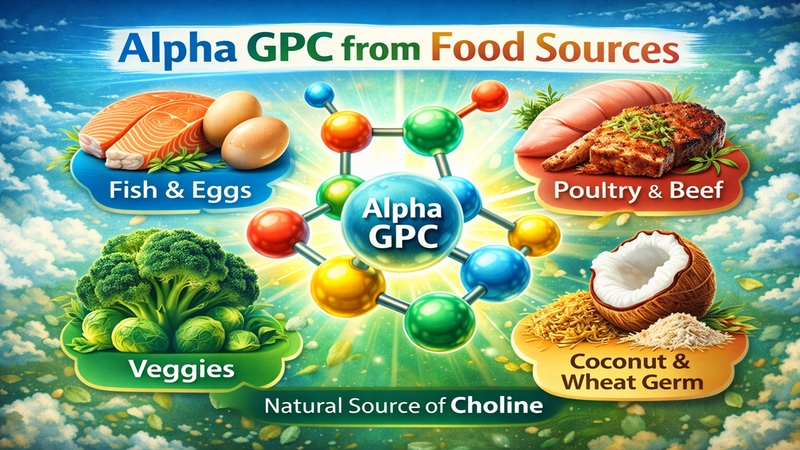
Animal foods top the list for Alpha-GPC. Beef liver provides 77.93 milligrams per 100 grams and is way at the top of the list. Other excellent choices are Atlantic cod with 30.04 milligrams per 100 grams, wheat germ with 33.78 milligrams per 100 grams, oat bran with 33.25 milligrams per 100 grams, and salmon with 5.89 milligrams per 100 grams.
Even everyday foods such as eggs with 0.60 milligrams per 100 grams, chicken breast with 1.12 to 1.20 milligrams per 100 grams, and pork sausage with 7.41 milligrams per 100 grams make a small contribution. Fruits and vegetables don’t compare; bananas, broccoli, and apples provide minimal amounts. Beer and coffee have a bit of Alpha-GPC, but these aren’t practical sources for performance-minded eaters.
For the majority, it’s plant-based choline that’s the real lever. Choline is a precursor for Alpha-GPC and promotes brain health, memory, and cognitive function. Layering in plant sources into your daily structure is a long-game move for your brain and nervous system resilience.
Plant-based choline sources include:
- Beans (soybeans, kidney beans, chickpeas)
- Nuts (almonds, walnuts, peanuts)
- Whole grains (quinoa, brown rice, wheat germ, oat bran)
- Leafy greens (spinach, broccoli)
- Seeds (flax, chia, pumpkin)
Food | Choline (mg/100g) |
Beef Liver | 418 |
Eggs | 251 |
Atlantic Cod | 65 |
Wheat Germ | 152 |
Oat Bran | 58 |
Soybeans | 116 |
Chicken Breast | 72 |
Broccoli | 40 |
Bananas | 9 |
Alpha-GPC in food is low and probably less bioavailable than supplements, so direct cognitive impacts from food alone are mild. Constructing a diet abundant in choline, from animal and plant sources, promotes brain health and general wellness over the long term.
Food Versus Supplements
Alpha-GPC is a choline compound, and choline itself is present in a diverse array of whole foods. Eggs, beef liver, milk, soybeans, and some fish are reliable providers. The body can transform this dietary choline into alpha-GPC as well, but in limited quantities.
For the majority of healthy adults eating a balanced diet, these foods have you covered. They provide not only choline but also protein, vitamins, and minerals that support recovery, muscle function, and brain health. In real food, nutrients appear as part of a system. It aids in absorption and cuts down on the possibility of excess.
Nootropic pouches like SPEAR give you an immediate dose of alpha GPC. Many supplements typically deliver hundreds of milligrams per capsule. The appeal is predictability and convenience, particularly for individuals whose diets fall short or for those who eschew animal products. Isolated compounds aren’t always as well absorbed as food nutrients.
The body’s uptake of choline from eggs, for instance, is generally better modulated than that from a concentrated pill. Other studies find that for the general population, supplements provide no obvious advantage in improving mood, attention, or cognitive function beyond a nutrient-dense diet.
Over-supplementing comes with its own dangers. Side effects of choline compounds in high doses have been associated with side effects such as hypotension, dizziness, and headaches. Certain supplements may interfere with medications or pre-existing conditions.
Quality control is another issue; what’s on the label isn’t necessarily what’s in the bottle. Athletic populations with higher needs or restrictions in their diet may find an advantage, but balance and doctor’s orders are important.
Its hard-line starts with food, eggs, liver, soy, fish, and then patches holes as necessary. A supplement is a tool, not a quick fix. If you’re looking at a choline supplement, discuss with a health care professional to balance your diet, health, and training requirements.
The Science of Dietary Alpha-GPC

Alpha-GPC isn’t a shortcut. It’s an excellent choline source for well-designed disciplined systems based on the long haul. Its molecular profile (C8H20NO6P, 257.221 g/mol) means it’s small enough for efficient absorption, but metabolism and impact vary based on individual gut microbiota and liver function.
The body can produce some alpha-GPC in the gut, but only in low quantities, such as E. Coli Top10. Its main role is a precursor to acetylcholine, vital for memory, learning, and muscle control. That’s why it’s commonly used by older adults seeking to promote brain resilience.
Studies are evident that alpha-GPC does not proclaim itself with a “kick.” Rather, its impact is nuanced and system-based. The evidence on physical performance is nuanced.
- 600 mg or more can acutely increase growth hormone secretion and support muscle repair and adaptation.
- Other research finds enhanced power output and response time in athletes and is sporadic across populations.
- No sign of overstimulation or harsh side effects at moderate doses.
Recent research indicates alpha-GPC might be neuroprotective, particularly in Alzheimer’s disease models. These mechanisms range from cholinergic transmission support to the reduction of inflammation in neural tissue. These effects appear encouraging, but this area remains nascent.
The connection between dietary alpha-GPC and cognitive function is most pronounced in individuals with choline deficiency or mild cognitive impairment. Proof of memory and focus improvements is more muted in healthy adults. Effects differ probably as a result of variations in absorption, metabolism, and baseline choline status.
It’s worth noting that alpha-GPC is converted by gut bacteria to TMA, then to TMAO in the liver. More TMAO means more heart risk, and large cohorts have associated high-dose alpha-GPC use with greater 10-year stroke risk. Other research presents enhanced lipid profiles and lowered serum glucose in some populations.
Preserving Alpha-GPC in Your Diet
Alpha-GPC is found in dairy products, organ meats, wheat germ, and some fish. These contain only small amounts compared to supplementation. Most athletes and disciplined lifters will fare better with a systems approach that supports choline status through consistent meal planning, not chasing single ingredients.

A checklist for practical meal planning:
- Focus on eggs, lean beef, and fish such as salmon or Atlantic cod. These provide choline, which your body can convert to Alpha-GPC.
- Add a daily serving of either broccoli, cabbage, or bananas. These are small players, but worth the accumulation.
- Organ meats, particularly liver, provide a concentrated source for the adventurous.
- Try rotating wheat germ into your oats, smoothies, or yogurt for an additional boost.
It’s about meal habits, not meals. Incorporate choline-rich foods into breakfasts, such as eggs and fish, lunches, like lean meats and cruciferous veggies, and snacks, including bananas and wheat germ. Aim for three to five servings per week of choline-rich foods. This stable rhythm trumps novelty.
Overcooking is your enemy. Alpha-GPC and other nutrients are heat sensitive. Heat, extended cooking, and repeated reheating all speed its degradation. Favor gentle methods: steam broccoli, poach fish, or soft-scramble eggs.
Stay away from deep frying or charring because they leach away delicate molecules. Minimize heat and air exposure. Prepare meals fresh, store airtight, and eat soon.
Whole foods, not processed, tend to keep this and precursors such as lecithin. Technological processing, long storage periods, and exposure to light all deplete nutritional value. Freshness is a performance tool.
Buying in small amounts, more often, and using ingredients fast helps you preserve what matters. Eat more raw or lightly cooked fruits and vegetables. Consume minimally processed dairy and meats.
Alpha-GPC’s bioavailability from food isn’t fully mapped, but oral administration does raise plasma choline. Daily consumption of choline-laden meals lays the foundation for mental and physical performance, even if each by itself feels small.
Conclusion
Alpha-GPC is found in very small amounts in foods such as eggs, dairy, and meats. Food sources provide only trace levels, which are sufficient for basal function but far below doses that research uses to achieve nootropic or performance effects. Cooking and food processing can strip even more alpha-GPC. For most, balanced diets address baseline demands.
Those aiming for higher doses for workouts or cognitive focus might turn to supplements since food alone cannot provide those researched doses. No nutrition hack supersedes the impact of consistent training, recovery, and sleep. Alpha-GPC operates behind the scenes. For most serious lifters, it is one of several choices for sustaining focus and energy over the long haul, not a substitute for consistent habits.
Frequently Asked Questions
What is alpha-GPC and why is it important?
Alpha-GPC is a natural choline compound found in some foods. It assists in the formation of acetylcholine, a crucial memory and learning neurotransmitter.
Which foods naturally contain alpha-GPC?
Eggs, meat, dairy and a few organ meats all have small amounts of alpha-GPC. Levels are typically low relative to supplements.
Can I get enough alpha-GPC from food alone?
It’s tough to obtain meaningful quantities of alpha-GPC from food alone. Most folks get higher doses via supplementation if desired. You should consider adding supplements that contain it like Flowblend's Spear150 mg of 99% pure Alpha GPC.
How does alpha-GPC in food compare to supplements?
Alpha-GPC in supplements is more concentrated and standardized. Food sources offer only trace amounts, and supplements are more efficient for larger quantities.
Does cooking affect alpha-GPC in food?
Heat and processing can destroy the alpha GPC in food. Fresh, minimally processed foods are the best sources.
Is alpha-GPC safe to consume from food?
Yes, alpha-GPC from natural food sources is likely safe for most people when consumed as part of a typical diet.
Are there any benefits to getting alpha-GPC from food instead of supplements?
Obtaining alpha-GPC from food provides a natural balance of nutrients and prevents overconsumption. It promotes overall food health.
Additional Topics: