
Best Nootropic Pouches (2026)
Updated August 2026 · 7 brands compared
Most "best nootropic pouch" lists are written by pouch brands that rank themselves first and never mention it.
We're a pouch brand. We rank ourselves first. And we're going to tell you exactly why, exactly what we weighted, and exactly where three other brands beat us — so you can check our work instead of taking our word for it.
Here's the short version: nootropic pouches are tobacco-free, nicotine-free pouches that sit under your lip and deliver cognitive ingredients through the lining of your mouth. The category is young, the labels are inconsistent, and the gap between what's on the front of a can and what's actually in the pouch is where most buyers get burned.
This guide fixes that. Seven brands, five criteria, one table, and an honest accounting of the trade-offs.
Our bias, stated up front
FlowBlend makes SPEAR, and SPEAR is ranked first on this page. You should factor that in.
Two things make that ranking checkable rather than self-serving. We publish the criteria before the ranking — five measurable axes, listed below, applied to every brand. If you weight them differently than we do, you'll get a different winner, and we tell you which brand wins under which weighting.
And we say where we lose. SPEAR costs more than twice what the budget picks charge per pouch. It comes in three flavors where one competitor offers eight. It has no caffeine, which makes it the wrong product for a lot of people. Those aren't buried — they're in the table and in our own entry.
Nobody paid to be on this list. Nobody could pay to move up. Every competitor number here came from that brand's own public listing, and all of it is dated in case they reformulate.
How we ranked
- Dose transparency. Does the label tell you the milligrams of each active ingredient, or does it hide behind a "proprietary blend"? Weighted heaviest, because everything else depends on it — you cannot judge a formula you cannot read.
- Actual doses vs. the research range. Disclosure is table stakes; the number has to be meaningful. Alpha-GPC is studied in the 150–400 mg range. A pouch disclosing 30 mg is honest but underdosed.
- Pouches per can. Fifteen is the most common count, but it runs from 15 to 20 depending on brand — easy to miss when you're comparing sticker prices instead of cost per pouch.
- Sweeteners and base. What's carrying the actives matters. We favored natural sweeteners — xylitol, stevia — over artificial ones.
- Price per pouch. Not sticker price. Can price divided by pouch count, the only number that compares a 15-count against a 20-count honestly.
Not ranked: flavor preference (subjective), packaging, and any marketing claim we couldn't verify against a public source.
The comparison table
| Brand | Key actives (per pouch) | Caffeine | Pouches/can | Price/pouch | Full mg disclosure |
|---|---|---|---|---|---|
| FlowBlend SPEAR | Alpha-GPC 150 mg · Rhodiola 50 mg · L-Theanine 40 mg · Uridine MP 15 mg | None | 20 | ~$0.75 | Yes |
| Nectr Focus | Cognizin® Citicoline 62.5 mg | 30 mg | 16 | ~$1.88–2.81 | Yes |
| Fully Loaded ALPHA | Alpha-GPC 60 mg · L-Tyrosine 60 mg · GABA 20 mg | None | 15 | ~$0.33 | Yes |
| Roon | L-Theanine 60 mg · Methylliberine 25 mg · Theacrine 5 mg | 80 mg | 15 | ~$1.33 | Yes |
| Ultra | Enfinity® Paraxanthine 100 mg, plus L-Theanine, Alpha-GPC, ginseng, B vitamins | None | 20 | ~$1.07 | Partial |
| Mojo | L-Theanine · Ginseng · Rhodiola · Tyrosine | 50 mg | 15 | ~$0.40 | Partial |
| Grinds | Coffee-based blend | 25–100 mg | 18 | ~$0.33 | Partial |
Competitor specifications taken from each brand's public product listings, retrieved August 2026. Formulas and prices change — check the current label before you buy. Where a brand doesn't publish a figure, we left it out rather than guess.
The ranking
1FlowBlend SPEAR
Best dose transparency · highest disclosed Alpha-GPC
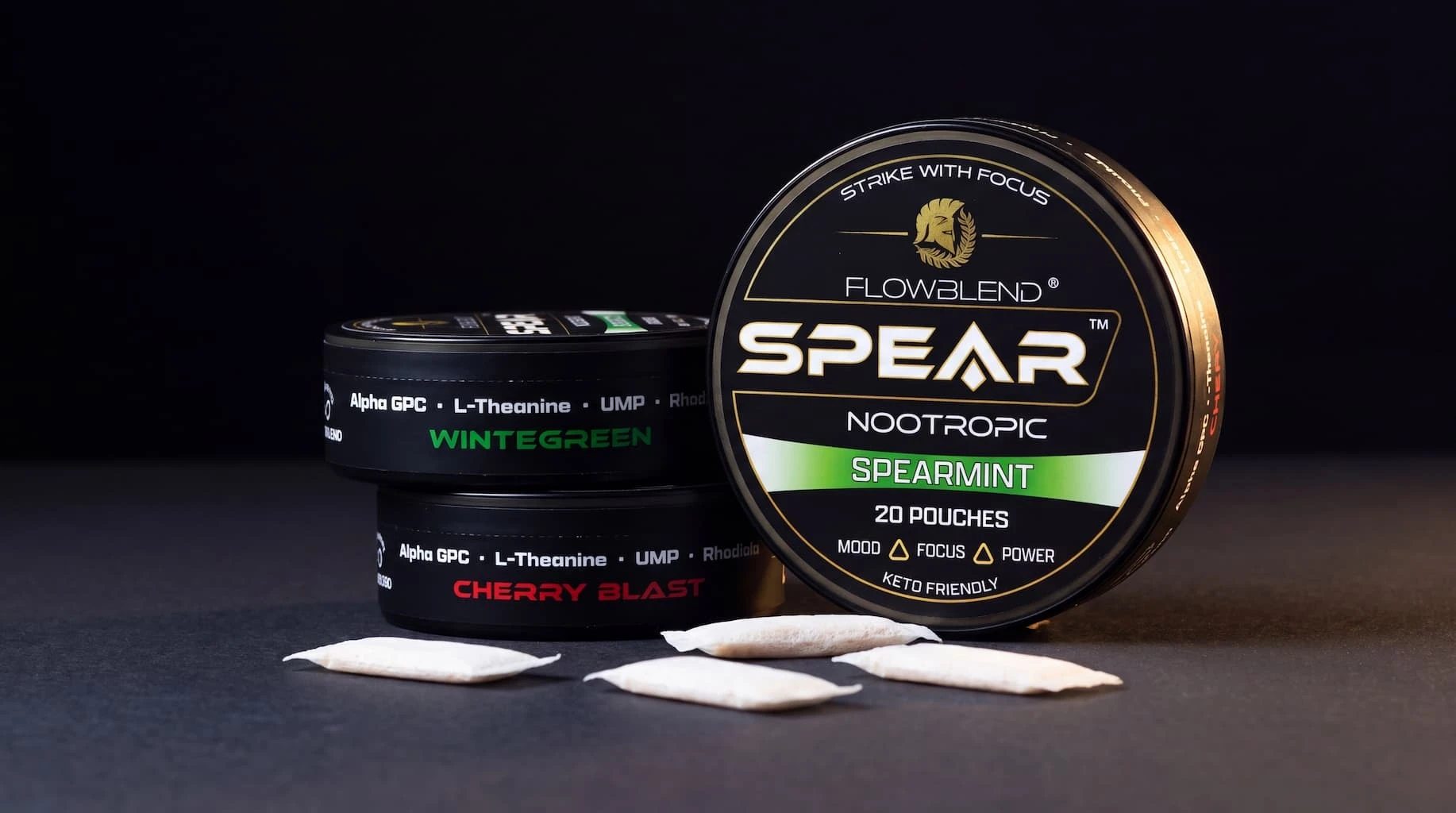
The case for itSPEAR discloses every active in milligrams on the front of the can: 150 mg Alpha-GPC, 50 mg Rhodiola rosea, 40 mg L-Theanine, 15 mg Uridine Monophosphate. The Alpha-GPC number is the one that matters most — 150 mg sits inside the range the research actually uses, and it's more than double the next-highest disclosed Alpha-GPC dose on this list.
You also get 20 pouches per can, where most of this category ships 15. That's a third more product per can, which narrows the per-pouch price gap considerably against cheaper-looking cans. (Ultra is the only other brand here that matches 20.)
It's caffeine-free by design, sweetened with xylitol and stevia rather than artificial sweeteners, formulated in-house in Kalispell, Montana, and third-party lab tested with COAs published per batch.
Worth knowing where this comes from: FlowBlend launched the first nootropic pouch in America in 2021. We built this category before it was a category, and the formula reflects five years of iterating on it rather than a recent entry into a trending format.
Honest limitsAt roughly $0.75 per pouch, SPEAR costs more than double the budget picks — if price is what decides it for you, Fully Loaded ALPHA or Grinds will serve you better. Three flavors, where one competitor offers eight. And no caffeine at all: if you want a stimulant kick with your focus, this is the wrong can and you should look at Roon or Nectr instead.
Best for: buyers who want a disclosed, research-range nootropic dose without caffeine, and who care more about what's in the pouch than what it costs.
Spearmint · Wintergreen · Cherry Blast · The Focus Stack 3-pack
2Nectr Focus
Strongest branded-ingredient story
The case for itNectr built its formula around Cognizin® Citicoline at 62.5 mg — a patented, branded form of citicoline with a genuine body of published research behind it. That's a real differentiator. Branded ingredients cost more to license and generally come with standardized manufacturing and actual trial data, which is more than most of this category can say. They disclose the dose clearly and pair it with 30 mg of caffeine, roughly a third of a cup of coffee — enough to notice, low enough to stay smooth.
Honest limitsIt's the most expensive option here by a wide margin: cans run roughly $30–45 for 16 pouches, several times what most of this list costs per pouch. It's also a single-nootropic formula — citicoline and caffeine, not a stack, which is either focus or a limitation depending on what you want. Their own comparison content cites "20+ peer-reviewed trials" without linking any of them, and their buyer's guide ranks Nectr first without disclosing that Nectr wrote it.
Best for: buyers who want one well-researched, patented ingredient with a light caffeine lift, and who aren't price-sensitive.
3Fully Loaded ALPHA
The value pick · widest flavor range
The case for itAt roughly $0.33 per pouch this is the cheapest genuine nootropic pouch on the list — less than half what SPEAR costs. If price is your top criterion, this is your can, and we'd rather tell you that than pretend otherwise. They disclose their doses: 60 mg Alpha-GPC, 60 mg L-Tyrosine and 20 mg GABA in the caffeine-free line. That's real transparency, and more than Mojo or Grinds offer. Eight flavors is the widest selection here by a distance, and there's a separate caffeinated line for people who want the stimulant.
Honest limitsThe Alpha-GPC dose is 60 mg — disclosed and honest, but well under the 150–400 mg range the research uses, and 90 mg less than SPEAR. Fifteen pouches per can rather than 20, so the per-can price advantage is larger than the per-pouch advantage. GABA's usefulness taken orally is debated.
Best for: budget-conscious buyers, and anyone who wants flavor variety more than a maximal dose.
4Roon
Most complete caffeinated stack
The case for itRoon discloses a full four-part formula: 80 mg caffeine, 60 mg L-Theanine, 25 mg methylliberine and 5 mg theacrine. Caffeine paired with L-theanine is the most-studied combination in this entire category, and Roon uses a sensible ratio of it. Methylliberine and theacrine are caffeine relatives with longer, flatter curves. Full milligram disclosure across the board, zero nicotine.
Honest limitsAt 80 mg this is the most caffeinated pouch here — close to a full cup of coffee — so it's a stimulant product first and a nootropic second. If you're using pouches specifically to get off the caffeine rollercoaster, this isn't the exit. It's also priced high: about $19.99 for a 15-pouch tin works out near $1.33 per pouch.
Best for: people who want their caffeine and their focus ingredients in the same pouch.
5Ultra
The most interesting formulation bet
The case for itUltra is built around Enfinity® paraxanthine at 100 mg, raised from 75 mg in January 2026. Paraxanthine is the compound your body converts caffeine into, and the argument for using it directly is a more predictable response without some of caffeine's rough edges. That headline dose is disclosed clearly and supported by a real stack — L-theanine, Alpha-GPC, panax ginseng and B vitamins. Ultra also ships 20 pouches per can, matching SPEAR for the most product per can on this list.
Honest limitsOnly the paraxanthine dose is published; the supporting ingredients are named without milligram amounts, so you can't tell whether the Alpha-GPC in there is a working dose or a label decoration. At about $1.07 per pouch it sits toward the expensive end. And paraxanthine has a far thinner research base than caffeine or Alpha-GPC — a promising newer ingredient, not a settled one.
Best for: people who react badly to caffeine and want to try the alternative.
6Mojo
Reasonable middle option, vaguer labeling
The case for itMojo pairs 50 mg of caffeine with recognizable nootropic support ingredients — L-theanine, ginseng, rhodiola and tyrosine. The caffeine level is moderate, the ingredient choices are sensible, and roughly $0.40 per pouch is fair for what it is.
Honest limitsThis is where disclosure starts breaking down. Caffeine is stated; the nootropic ingredients are named but not consistently given individual milligram amounts. Named-but-not-dosed means you can't tell whether the rhodiola is a real dose or a label decoration — the exact problem our first criterion exists to catch.
Best for: buyers who want moderate caffeine and aren't dose-focused.
7Grinds
Excellent at what it is, which isn't quite this
The case for itGrinds has been making coffee pouches longer than most of this category has existed, ships 18 per can, runs about $0.33 per pouch and offers a genuinely enormous flavor range. It's a well-run product with real customers who love it.
Honest limitsIt's a coffee pouch, not a nootropic stack. Caffeine runs 25–100 mg depending on the line, and there's no disclosed nootropic formula behind it. It's here because it shows up in the same searches and buyers deserve to know the difference — not because it's competing on the same axes.
Best for: people who want coffee in pouch form and aren't shopping for a nootropic formula.
How to choose: a short buyer's guide
Read the back, not the front
The front of the can sells you a feeling. The back tells you whether you're buying anything. If a brand names ingredients without milligrams, assume the doses are small — disclosure is cheap when the numbers are good.
Check the dose against the research, not against zero
"Contains Alpha-GPC" is not a specification. Alpha-GPC is studied around 150–400 mg. Anything meaningfully under that is present, but working at a fraction of what the studies used. The same logic applies to every active on the label.
Do the per-pouch math
A $12 can of 15 and a $15 can of 20 look like a $3 gap. They're $0.80 versus $0.75 — the cheaper-looking can is the more expensive pouch. Divide every time. On this list, per-pouch cost spans roughly $0.33 to nearly $3.00, and the sticker prices don't tell you that.
Decide on caffeine first
It's the biggest fork on this list. Caffeine-forward pouches (Roon, Nectr, Grinds) give you a lift you'll feel quickly. Caffeine-free pouches (SPEAR, Fully Loaded ALPHA) are built for people who already get plenty of caffeine, or who want focus without adding another stimulant to the day.
Look at what's carrying the actives
Sweeteners, fillers and base material vary widely and rarely appear in marketing. Natural sweeteners like xylitol and stevia are a reasonable thing to prefer. And ask whether anyone tested it — third-party lab testing with published COAs is still uncommon in this category, so when a brand publishes them, that's a real signal.
Frequently asked questions
Are nootropic pouches worth it?
It depends entirely on the label. A pouch disclosing research-range doses of studied ingredients is a reasonable way to take them — fast, portable, nothing to brew or swallow. A pouch hiding a proprietary blend is a flavored placebo at a premium price. The format isn't the variable; the formula is.
Do nootropic pouches actually work?
The ingredients are what work, and only at real doses. Alpha-GPC, L-theanine and caffeine all have substantial research behind them at specific amounts. The pouch is a delivery method — it holds the ingredients against the inside of your cheek so they absorb through the lining of your mouth rather than going through digestion. That's why the milligram numbers on the label matter more than anything else on the can.
How are nootropic pouches different from ZYN?
ZYN is a nicotine pouch. Nootropic pouches contain no nicotine and no tobacco — they use cognitive ingredients instead. Same format, same routine, entirely different contents. People often move across because they like the pouch format itself.
How long until I feel something?
Most people notice something in the 15–30 minute range. It's a clear, steady kind of sharp — not a jolt. If you're expecting an energy-drink hit from a caffeine-free pouch, you'll be disappointed by design.
Are there caffeine-free nootropic pouches?
Yes. SPEAR and Fully Loaded ALPHA are both caffeine-free. Nectr, Roon, Mojo and Grinds all contain caffeine in varying amounts. If you're keeping total daily caffeine down, check this before you buy — it isn't always obvious from the front label.
How many pouches come in a can?
It varies more than people expect. Fifteen is the most common count — Fully Loaded ALPHA, Roon and Mojo all ship 15. Nectr ships 16, Grinds 18, and FlowBlend SPEAR and Ultra both ship 20. It's the single easiest spec to overlook and it changes your real cost per pouch significantly.
What should I look for on the label?
Milligrams next to every active ingredient, doses that land in the range the research uses, the pouch count, the sweetener, and whether the brand publishes third-party lab results. If the first one is missing, the rest is marketing.
The honest summary
If you want the highest disclosed Alpha-GPC dose, 20 pouches a can and no caffeine, SPEAR is the one — and it'll cost you more than double what the budget picks charge. If price leads, buy Fully Loaded ALPHA or Grinds. If you want caffeine with your focus, Roon or Nectr. We'd rather you buy the right can than the wrong one from us.
Shop nootropic pouches Try the Focus StackAll trademarks are the property of their respective owners. FlowBlend is not affiliated with, sponsored by, or endorsed by any other brand named on this page. Competitor specifications were taken from public product listings in August 2026 and may change.
These statements have not been evaluated by the Food and Drug Administration. This product is not intended to diagnose, treat, cure, or prevent any disease.